

Search intent cannibalization occurs when multiple pages on the same website are built to satisfy essentially the same searcher need, even when they target different keywords.
The problem is not simply that two URLs rank for the same term. The real question is whether those URLs are competing to be the answer to the same underlying query intent.
For example, “keyword cannibalization” and “how to prevent pages competing in Google” use different wording, but they may lead to the same user task: understanding and resolving competing pages.
That distinction matters because multiple URLs appearing for related queries is not automatically a problem. Ahrefs notes that two pages can rank for the same query successfully when their search intents differ.
The practical rule is simple:
Do not fix ranking overlap. Fix genuine intent and page-purpose overlap.
What Search Intent Cannibalization Actually Means
Traditional keyword cannibalization focuses on repeated target keywords. Search intent cannibalization goes one level deeper.
| Situation | What overlaps? | Potential problem |
|---|---|---|
| Two pages target “SEO audit” | Keyword | Possible keyword cannibalization |
| “SEO audit guide” + “how to perform an SEO audit” | User need | Possible intent cannibalization |
| Blog post + SEO audit service page | Topic, but different purpose | Usually differentiation is possible |
| Two guides answering the same SEO audit questions | Purpose and content | Stronger cannibalization risk |
The important distinction is page purpose.
A site can legitimately have several pages about the same subject. A definition page, implementation guide, product page, and service page can coexist because each serves a different user task.
The problem begins when two URLs could reasonably be substituted for one another by the same searcher.
How to Detect Search Intent Cannibalization
Start with Google Search Console rather than changing pages based only on keyword reports.
Google’s Search Console Performance reporting allows you to analyze queries and pages, including clicks, impressions, CTR, and average position.
Google’s documentation explains how the Performance report can be filtered by queries and pages to examine which URLs appear for a particular search
SearchEngineZine’s existing cannibalization workflow similarly recommends selecting a suspected query and examining which URLs Google associates with it.
For a broader framework for mapping search queries to their underlying intent, see our keyword intent analysis framework.
Use this sequence:
1. Find overlapping queries
In Search Console → Performance → Search results, identify a query or query group that appears to generate impressions for multiple URLs.
This is a diagnostic signal—not proof of cannibalization.
2. Compare the actual pages
For every competing URL, compare:
- Primary search intent
- Page purpose
- Target audience
- Main question answered
- Content coverage
- Search-result positioning
- Internal-link role
- Conversion or next-step purpose
3. Apply the Same-Searcher Test
Ask:
If the same person searched this topic, would either page give them essentially the same answer?
If yes, the pages deserve a deeper overlap review.
If no, the apparent competition may simply reflect legitimate coverage of different intents.
4. Compare the SERPs
Search the different keyword expressions manually.
If substantially the same competitor pages appear for both queries, that is useful evidence that Google interprets the searches similarly. It is still a diagnostic clue rather than proof of a ranking penalty.
When Multiple Ranking Pages Are Not Cannibalization
This is the most important qualification.
Multiple pages from the same domain can rank for the same query without requiring consolidation. Ahrefs gives an example in which two pages rank for “YouTube search terms” but satisfy different intents: one provides information, while the other provides a keyword research tool.
Consider this structure:
Page A: What is keyword cannibalization?
Page B: How to audit keyword cannibalization
Page C: Keyword cannibalization remediation service
These pages share a subject but have different jobs.
The correct objective is therefore not:
One keyword = one URL.
A better model is:
One distinct searcher need = one clear primary page purpose.
That distinction prevents unnecessary merging.
A Practical Intent-Overlap Test
Before merging two URLs, score the relationship qualitatively across five questions:
| Test | Question |
|---|---|
| Intent | Do both pages satisfy the same search intent? |
| Purpose | Do both pages have essentially the same job? |
| Audience | Are they written for the same type of searcher? |
| Coverage | Does one page substantially duplicate the other’s useful information? |
| Destination | Would a searcher be equally satisfied landing on either URL? |
If most answers are yes, investigate consolidation or differentiation.
If the answers are mostly no, the pages may simply be related resources.
This is more reliable than treating shared words or similar titles as automatic evidence of cannibalization.
How to Fix Genuine Search Intent Cannibalization
There is no universal fix. The correct action depends on why the pages overlap.
Consolidate when two pages serve the same job
If two articles substantially answer the same question, combine their strongest material into one definitive resource.
Yoast describes consolidation as one of the practical responses to overlapping content and recommends evaluating performance before deciding which URL to retain.
Redirect when the old URL has been replaced
If one page is genuinely being retired and its purpose is absorbed by another URL, a permanent redirect can connect the old destination with the new one.
Do not redirect unrelated pages merely to eliminate overlapping keywords.
Differentiate when both pages deserve to exist
Sometimes the right solution is not consolidation.
For example:
- Informational: What is SEO keyword cannibalization?
- Diagnostic: How to identify competing URLs
- Commercial: Keyword cannibalization audit service
The subject is related, but the user task changes.
Make the distinction explicit through titles, headings, content scope, internal links, and page purpose.
Use canonicalization only for appropriate duplicate situations
A canonical tag is not a general-purpose cannibalization solution.
If two pages have substantially different purposes, canonicalization does not solve the underlying intent problem. Google treats canonicalization as a way of selecting a representative URL for duplicate or substantially similar content, and the canonical signal is only a hint rather than an absolute directive.
Use noindex for pages that have a legitimate non-search purpose
A page that needs to remain accessible but should not appear in search can have a legitimate noindex use case.
That is different from saying:
“These two pages rank for similar keywords, so one should be noindexed.”
The indexing decision should follow the page’s actual role. For a deeper implementation process covering content overlap and remediation decisions, see our guide to pruning cannibalized content
Prevent Cannibalization Before Publishing
The cheapest cannibalization fix is made before the second page exists.
Before approving a new article, record four things:
Search intent → Page purpose → Target URL → Supporting content
Then ask:
- Does an existing URL already satisfy this intent?
- What specifically will the new page do that the existing page does not?
- Would updating the existing page solve the user’s problem more efficiently?
- If a new URL is justified, how will it differ?
- Which existing page should link to it?
This turns cannibalization prevention into an editorial planning process rather than a post-publication cleanup exercise.
SearchEngineZine’s keyword research framework similarly emphasizes mapping specific intents and keyword clusters to clearly defined pages to reduce overlapping coverage.
The Key Distinction: Keyword Overlap vs. Intent Overlap
Keyword overlap is easy to detect.
Intent overlap requires interpretation.
That is why a site can have:
Different keywords + same intent = potential cannibalization
while also having:
Same keyword + different intent = potentially legitimate coexistence
Google’s documentation also emphasizes the importance of contextual, descriptive internal links so users and search engines can understand the relationship between pages.
The goal is therefore not to make every page unique at the vocabulary level. It is to make every important URL’s purpose clear.
A Six-Step Search Intent Cannibalization Workflow
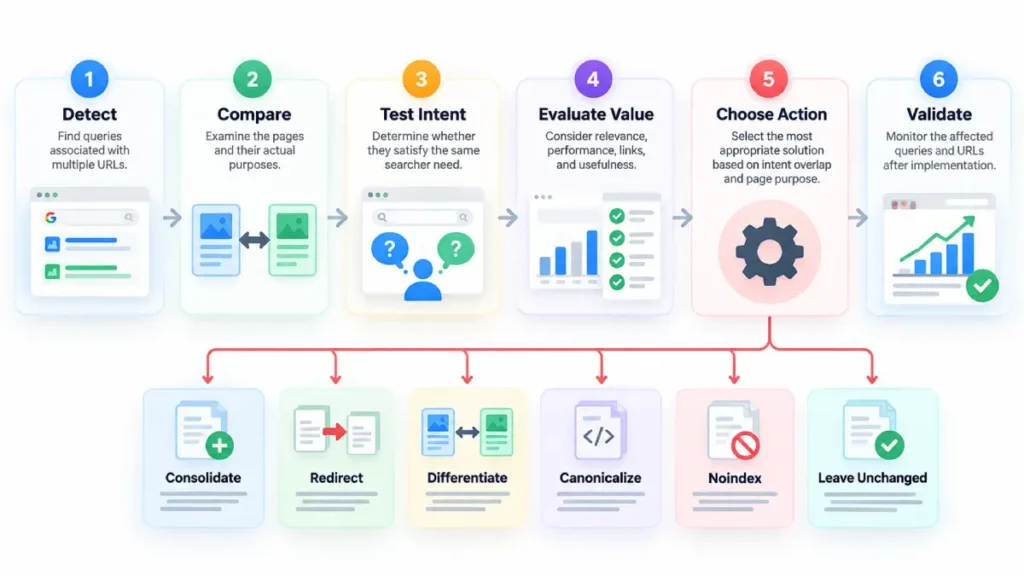
Use this workflow whenever multiple URLs appear to compete:
- Detect — Find queries associated with multiple URLs.
- Compare — Examine the pages and their actual purposes.
- Test intent — Determine whether they satisfy the same searcher need.
- Evaluate value — Consider relevance, performance, links, and usefulness.
- Choose an action — Consolidate, redirect, differentiate, canonicalize, noindex, or leave unchanged.
- Validate — Monitor the affected queries and URLs after implementation.
The critical step is Step 3.
Without an intent comparison, an SEO audit can turn legitimate topic coverage into unnecessary consolidation.
Conclusion
Search intent cannibalization is best understood as a page-purpose problem, not simply a keyword problem.
Two URLs appearing for the same query does not automatically mean something is wrong. The stronger diagnostic question is whether those pages are competing to satisfy the same searcher need.
When they are, choose a deliberate response: consolidate genuinely redundant content, redirect a retired URL, differentiate pages with distinct purposes, or use indexing controls where their specific purpose justifies them.
When their intents are genuinely different, leaving both pages in place may be the correct architectural decision.
The objective is not fewer URLs. The objective is clearer ownership of search intent.