
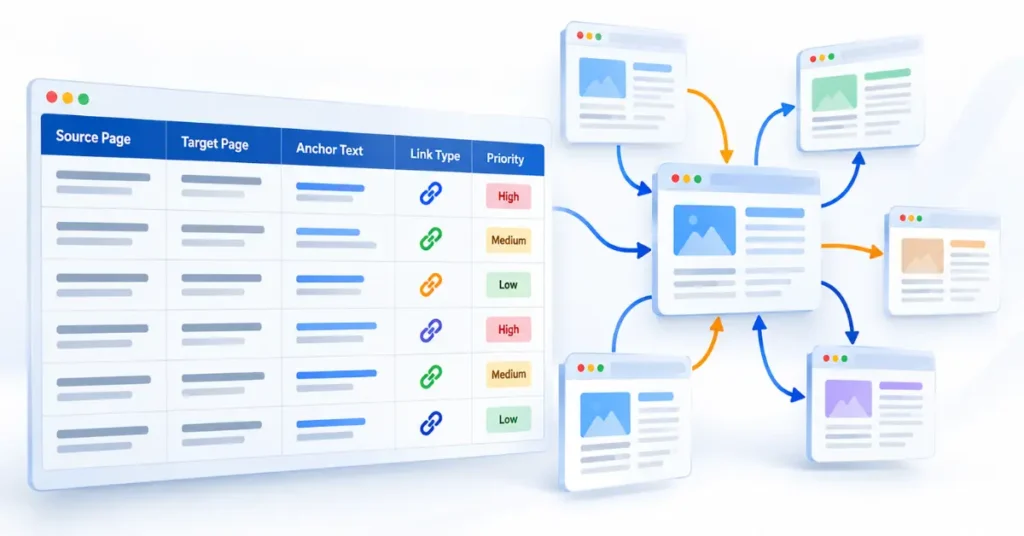
An internal linking matrix is a planning table that maps which pages on a website should link to which other pages, why the relationship exists, what anchor text to use, where the link should appear, and how important the link is.
It turns internal linking from an ad-hoc publishing task into a repeatable system. A practical matrix can contain columns such as Source Page, Target Page, Anchor Text, Link Type, Context, Priority, Status, and Review Date.
Google does not publish an official framework called an “internal linking matrix.” The matrix is an SEO planning method built around Google’s documented principles: important pages should be reachable through internal links, links should be crawlable, and anchor text should describe the destination clearly.
For an SEO professional, the real value of the matrix is not producing more links. It is deciding which relationships are worth creating and which should be left alone.
[IMAGE-01: Internal linking matrix showing source pages, target pages, anchor text, relationship type, priority, and implementation status]
What an Internal Linking Matrix Looks Like
A basic matrix can be structured like this:
| Source Page | Target Page | Anchor Text | Link Type | Priority | Status |
|---|---|---|---|---|---|
| SEO fundamentals guide | Topic cluster guide | topic cluster model | Contextual | High | Planned |
| Topic cluster guide | Anchor text guide | anchor text optimization | Contextual | High | Live |
| Technical SEO article | Orphan pages guide | orphan page detection | Contextual | Medium | Planned |
| Anchor text guide | Internal linking strategy | internal linking strategy | Contextual | High | Planned |
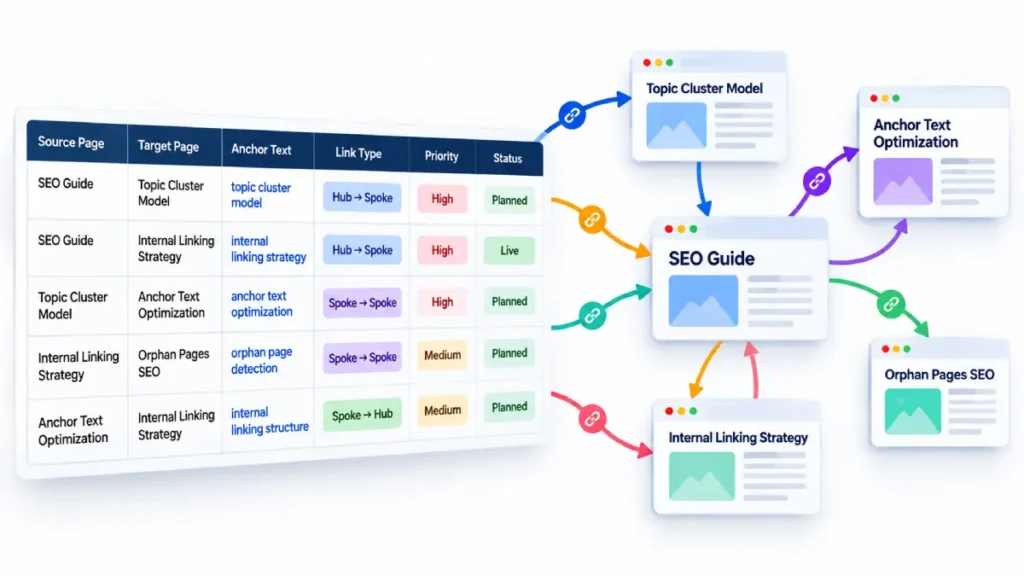
Each row represents one intended relationship, rather than simply one keyword.
That distinction matters. A page should not receive a link merely because the same keyword appears somewhere in both documents. The destination should genuinely help the reader at that point.
Why Use a Matrix Instead of Adding Links as You Publish?
Ad-hoc linking creates an obvious problem as a site grows: the newest articles receive attention while older, strategically important pages can become isolated.
Google specifically recommends that every page you care about should have a link from another page on your site and that internal links should use descriptive, relevant anchor text, as outlined in its guidance on crawlable links
A matrix adds three useful controls:
- Coverage — important pages can be checked for inbound links.
- Direction — you can deliberately connect hubs, clusters, supporting pages, and commercial pages.
- Prioritization — your team can implement the most useful relationships first.
This is particularly valuable when hundreds or thousands of URLs make page-by-page decisions difficult to manage. A structured topic cluster architecture can then provide the broader organizational context for those relationships.
The Core Columns of an Internal Linking Matrix
A useful matrix does not need dozens of fields. Start with the fields that affect the actual linking decision.
| Column | What it records |
|---|---|
| Source Page | Where the link will be placed |
| Target Page | The destination URL |
| Anchor Text | The visible clickable text |
| Link Type | Hub → spoke, spoke → hub, lateral, conversion, etc. |
| Context | Why the target helps the reader |
| Priority | High, medium, or low |
| Status | Planned, live, rejected, or needs review |
| Review Date | When the relationship should be reassessed |
For larger operations, add owner, implementation date, target page type, source-page strength, business value, and notes.
The important point is to keep the matrix operational. If a column does not change the linking decision or implementation process, it probably does not belong in the first version.
The anchor text field is particularly important because it records how the relationship is communicated to the reader.
How to Build an Internal Linking Matrix
1. Build the page inventory
Start with the URLs that actually matter.
Separate them into useful roles such as:
- Pillar or hub pages
- Cluster articles
- Supporting articles
- Product or service pages
- Category pages
- Conversion pages
- Important evergreen resources
Do not begin by trying to connect every URL to every other URL.
2. Group pages by topic and intent
Next, identify which pages belong together.
For example:
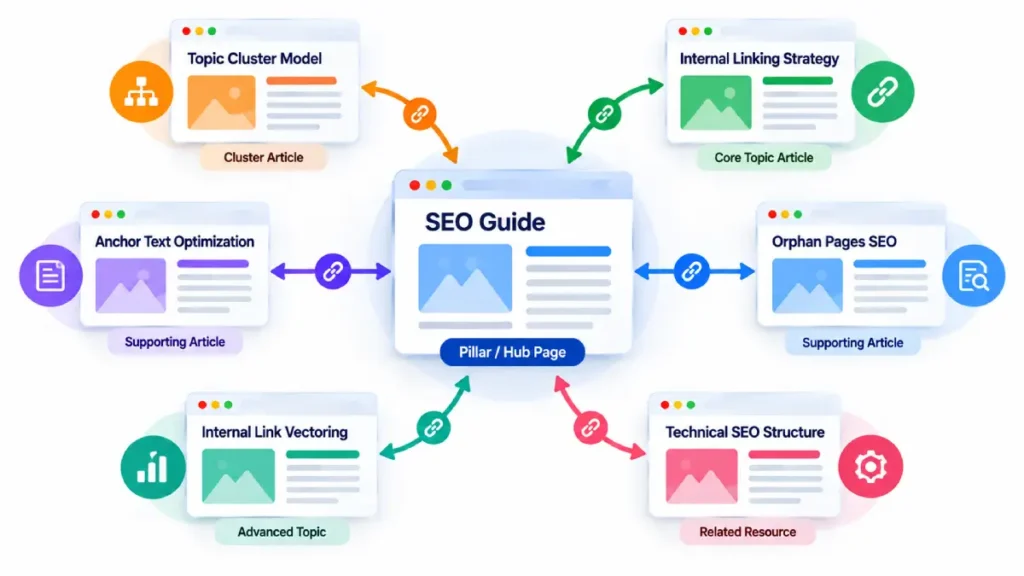
SEO Architecture
→ Topic Clusters
→ Internal Linking
→ Anchor Text
→ Orphan Pages
→ Semantic Site Structure
This creates the conceptual foundation for the matrix and helps establish a topic-cluster structure before individual links are assigned.
SearchEngineZine already has related resources covering anchor text optimization, orphan pages, topic clusters, internal link vectoring, and site structure, making these useful examples of how a link matrix can operate across a connected SEO content ecosystem.
3. Identify the strongest page relationships
For every possible source-target pair, ask:
If the reader is currently reading the source page, would the target page materially improve their understanding or next action?
If the answer is no, do not create the link. This distinction becomes particularly useful when automated semantic systems generate potential relationships that still require human qualification.
This prevents the common mistake of turning a matrix into a link quota.
4. Assign the relationship type
Useful relationship types include:
- Hub → Spoke — a broad page introduces a narrower topic.
- Spoke → Hub — a detailed article returns the reader to the broader framework.
- Spoke → Spoke — two closely related subtopics genuinely support each other.
- Educational → Commercial — an informational page links to a relevant product or service.
- Commercial → Educational — a product or service page links to supporting evidence or explanations.
A good matrix, therefore, represents the site’s information architecture, not merely its keywords.
5. Choose descriptive anchor text
Google recommends descriptive, concise, relevant anchor text rather than vague phrases.
For example:
Weak:
“Read more”
Better:
“internal linking matrix”
Better when the destination specifically covers the concept:
“how to build an internal linking matrix”
The anchor should fit naturally into the sentence. Avoid forcing an exact-match keyword where it makes the copy awkward.
SearchEngineZine’s own Anchor Text Optimization: Internal Link Distribution Architecture can serve as a deeper resource for anchor planning.
6. Prioritize implementation
Not every planned link deserves equal attention.
A practical priority model is:
High priority
- Important pages with weak internal support
- Key hub pages
- Important conversion pages
- Pages that are difficult to discover
- Strong contextual relationships
Medium priority
- Useful cluster-to-cluster relationships
- Supporting evergreen content
- Secondary commercial pathways
Low priority
- Weak semantic relationships
- Redundant destinations
- Links that add little information beyond existing navigation
The matrix should therefore become an implementation queue, not simply a documentation spreadsheet.
A Practical Internal Linking Matrix Example
Imagine an SEO site with five pages:
/seo-guide//topic-clusters//internal-linking//anchor-text//orphan-pages/
The matrix could look like this:
| Source | Target | Anchor | Relationship | Priority |
|---|---|---|---|---|
| SEO Guide | Topic Clusters | topic cluster model | Hub → Spoke | High |
| Topic Clusters | Internal Linking | internal linking | Spoke → Spoke | High |
| Internal Linking | Anchor Text | anchor text optimization | Spoke → Spoke | High |
| Internal Linking | Orphan Pages | orphan page detection | Spoke → Spoke | High |
| Anchor Text | Internal Linking | internal linking strategy | Spoke → Hub | Medium |
| Orphan Pages | Internal Linking | internal linking structure | Spoke → Hub | Medium |
Notice that the matrix does not connect every page with every other page.
That is intentional.
A useful internal-link architecture is selective. The purpose is to create meaningful paths between related information, not maximize link count.
How to Turn the Matrix Into an Audit
Once the matrix exists, it can become an ongoing maintenance system.
Compare the planned relationship with the live site:
| Check | Question |
|---|---|
| Destination | Does the target URL still exist? |
| Relevance | Does the target still satisfy the source context? |
| Anchor | Is the anchor descriptive and natural? |
| Placement | Is the link placed where the reader benefits? |
| Status | Is the planned link actually live? |
| Direction | Does the relationship still make sense? |
| Duplication | Is the same destination unnecessarily repeated? |
Google’s documentation emphasizes crawlable HTML links and descriptive anchor text. A standard <a href="..."> link is the reliable foundation for crawlability.
A sitemap can help search engines discover URLs, but it does not replace good internal linking. Google describes sitemaps as an additional discovery mechanism and notes that properly linked sites allow Google to discover important pages through navigation and internal links.
The Matrix Should Evolve With the Site
An internal linking matrix is not a one-time spreadsheet.
Every new article creates potential relationships with existing pages. Every deleted or consolidated page can invalidate existing relationships. Major content restructuring can also change which pages deserve internal support.
A simple maintenance cycle is:
Publish → map relationships → implement links → crawl → verify → update matrix
For larger sites, maintain the matrix as a living editorial asset rather than a document that is created once and forgotten.
SearchEngineZine’s Orphan Pages SEO guide is particularly relevant when using the matrix to identify pages that lack inbound internal support.
What an Internal Linking Matrix Should Not Become
Avoid five common mistakes:
- Linking everything to everything — this creates noise rather than useful architecture.
- Using keyword overlap as the only matching method — semantic usefulness matters more than identical words.
- Forcing exact-match anchors everywhere — natural, descriptive language is preferable.
- Treating the matrix as proof of SEO performance — it documents and manages implementation; performance still needs measurement.
- Leaving it unchanged after publication — content, URLs, and priorities evolve.
The strongest matrix is therefore not the largest one. It is the one that accurately represents the site’s most useful information pathways.
Internal Linking Matrix vs. Internal Linking Audit
These terms describe different stages of the same workflow.
| Internal Linking Matrix | Internal Linking Audit |
|---|---|
| Plans relationships | Examines existing relationships |
| Usually created before implementation | Usually performed on the live site |
| Identifies intended links | Identifies missing or problematic links |
| Assigns priority | Assigns remediation priority |
| Tracks implementation | Verifies implementation |
They work best together:
Audit → Matrix → Implementation → Re-crawl → Audit
That turns internal linking from an occasional SEO cleanup exercise into a controlled site-architecture process.
Conclusion
An internal linking matrix is a structured map of intended page-to-page relationships. Its purpose is not to increase the number of internal links indiscriminately. Its purpose is to make linking decisions explicit, relevant, prioritized, and maintainable.
For an SEO professional, the most useful matrix is usually simple: source URL → target URL → descriptive anchor → relationship → context → priority → status.
Google’s documented guidance supports the underlying principles: important pages should be reachable through links, links should be crawlable, and anchor text should help users and search engines understand the destination.
The matrix is the operational layer that turns those principles into a repeatable editorial workflow.