
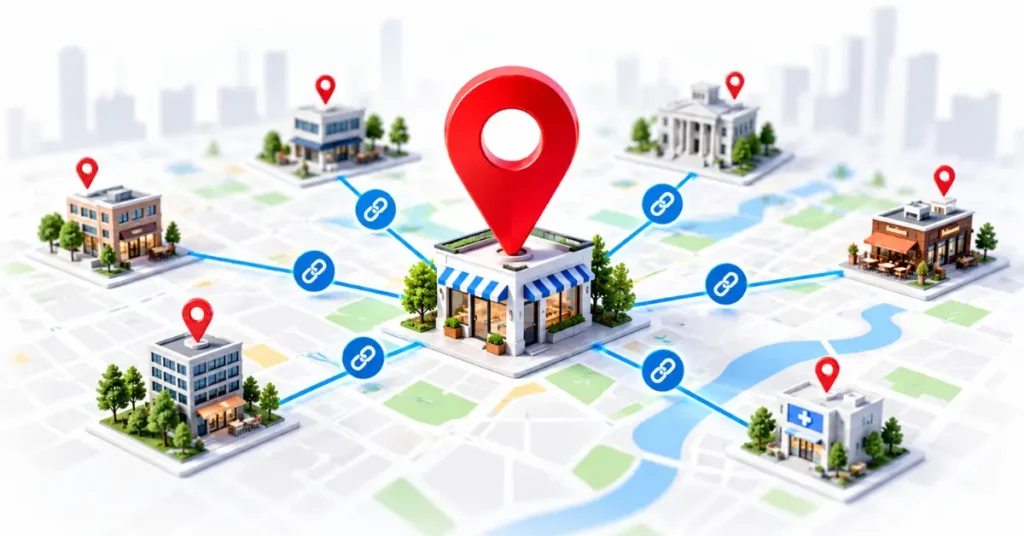
Hyperlocal link building is an advanced local SEO strategy designed to acquire backlinks from digital entities operating within a highly confined geographic footprint, typically a specific ZIP code, neighborhood, or 1-to-5-mile radius around a physical business location.
Unlike standard local link building, which targets city-wide press or state directories, hyperlocal strategies secure links from micro-community blogs, neighborhood business associations, local sports leagues, district news outlets, and hyper-adjacent local businesses.
For SEO professionals, this hyper-targeted backlink profile passes explicit geographic proximity signals and localized entity relevance to search algorithms.
As Google refines its proximity algorithms and neural matching for local search intent, earning links from neighborhood-level domains directly reinforces a business’s local entity node, boosting top-three Local Pack visibility and hyper-specific organic rankings where broad city-level link building fails to move the needle.
Hyperlocal vs. Traditional Local Link Building: Structural Comparison
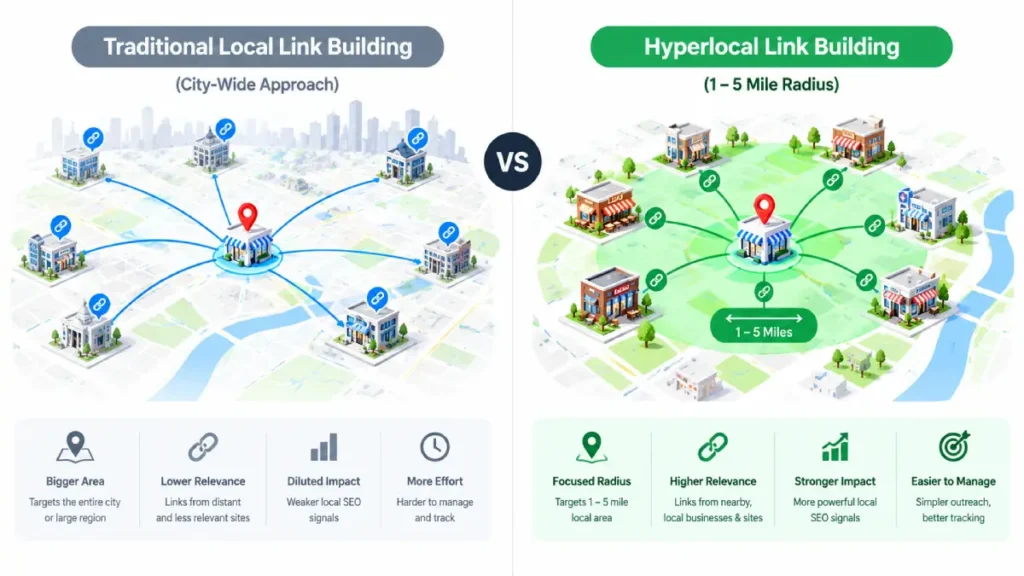
To understand why traditional local link building frequently underperforms in competitive suburban or dense urban environments, agency team leads must evaluate how geographic granularity impacts search engine entity graphs.
| Metric / Dimension | Traditional Local Link Building | Hyperlocal Link Building |
| Geographic Radius | City, metropolitan area, or statewide (10–50+ miles) | Neighborhood, suburb, or ZIP code (1–5 miles) |
| Primary Link Targets | Regional newspapers, state chambers of commerce, major directories | Neighborhood news blogs, youth leagues, local event organizers, adjacent B2B partners |
| Algorithmic Signal | Broad regional authority and general industry relevance | Specific geographic proximity and tight neighborhood co-location |
| Outreach Conversion Rate | Moderate (1% – 5% cold outreach success) | High (15% – 35% warm outreach/relationship-based) |
| Impact on GMB/GBP | General domain authority boost across the metro area | Direct proximity boost in target micro-geographies |
While securing links from a regional newspaper establishes broad domain trust, a hyperlink embedded inside a neighborhood block-association website sends an undeniable signal regarding physical presence.
Combining both forms a comprehensive strategy, but hyperlocal links act as the definitive tie-breaker when competing against rival businesses within tight geographical radii. For broader foundational concepts, review SearchEngineZine’s comprehensive local SEO guide.
The Neighborhood Entity Association Framework
Modern search engines process local entities by connecting physical location addresses, Structured Data, localized search queries, and web co-occurrences.
When Google parses a webpage linking to your business, it evaluates both the topical relevance of the referring domain and its geographical co-location attributes.
[Target Business Entity]
       │
       ├── Neighborhood Co-Occurrence ──► [Local Chamber / Block Group]
       ├── Geographic Proximity Node ────► [ZIP Code / Micro-Media Outlet]
       └── Co-Marketed Entity Signal ───► [Non-Competing Nearby Merchant]
Executing a successful hyperlocal link acquisition program requires building a Neighborhood Entity Association Framework. This involves identifying local digital assets that share explicit location markers with your target business:
- Geographic Proximity Co-occurrence: Pages that mention specific local landmarks, street intersections, neighborhood names, and ZIP codes alongside your brand name.
- Local Schema Integration: Websites that utilize Google’s LocalBusiness Schema recommendations to define precise latitude and longitude boundaries.
- Micro-Audience Overlap: Digital spaces actively consumed by residents residing within the immediate service footprint of the business.
4 High-Yield Hyperlocal Link Acquisition Strategies
1. Micro-Community Sponsorships & Civic Infrastructure
Standard corporate sponsorship strategies usually default to university endowments or major regional charities. Hyperlocal outreach shifts the focus to low-cost, neighborhood-level civic initiatives:
- Youth Sports Teams & Little Leagues: Local teams often maintain websites hosted on platforms like LeagueApps or SportsEngine. Sponsoring a neighborhood team routinely earns a direct homepage or sponsor-wall backlink with exact geographic contextual relevance.
- Neighborhood Block Parties & Farmers Markets: Community events frequently host dedicated partner pages. Providing micro-sponsorships ($50–$200) or donating venue space yields durable, local links on high-relevance neighborhood domains.
- Local School Clubs & PTA Chapters: High school athletic boosters, robotics clubs, and PTA newsletters offer prime opportunities for neighborhood link insertion via event sponsorship or community support pages.
2. Geo-Targeted B2B Cross-Promotion Hubs
Establishing structured co-marketing relationships with non-competing merchants within the same commercial corridor creates a resilient network of hyperlocal backlinks.
- Recommended Local Vendor Pages: A local plumber can partner with nearby hardware stores, real estate agents, and home inspectors to publish a curated “Trusted Neighborhood Home Services” resource guide.
- Neighborhood Discount/Perk Exchanges: Create a joint landing page offering exclusive discounts to employees or customers of adjacent local businesses. Each participating vendor links to the shared resource from their own domain.
3. Hyperlocal News Sites and Neighborhood Blogs
While regional daily newspapers are increasingly difficult to pitch, suburban digital publications, Substack neighborhood newsletters, and local community blogs actively seek neighborhood-centric content.
- Local Data Studies: Synthesize publicly available municipal or local real estate data into neighborhood-level reports (e.g., “Top Neighborhood Commercial Growth Corridors in [District Name]”).
- Community Feature Stories: Pitch local business founders as expert commentators on community developments, civic improvements, or localized industry shifts.
4. Reclaiming Unlinked Neighborhood Brand Mentions
Many neighborhood blogs, community associations, and civic portals mention local businesses without including a hyperlink.
- Perform specialized advanced search queries (e.g.,
"Brand Name" + "Neighborhood Name" -site:yourdomain.com). - Reach out with a courteous email emphasizing how adding a hyperlink improves user experience for residents navigating to your business location. For specialized anchor balancing tactics, see SearchEngineZine’s guide to anchor text optimization.
Technical Validation & Anchor Text Strategy
Acquiring hyperlocal links requires strict oversight regarding anchor text distribution and technical implementation. Over-optimizing with exact-match geo-anchors (e.g., “best plumber in downtown Austin”) across low-tier local sites can trigger algorithmic spam filters.
Hyperlocal Anchor Text Distribution Target:
- Brand Name + Neighborhood (e.g., "Smith HVAC Lincoln Park"): 40%
- Partial Match / Geo-Contextual (e.g., "servicing the North End district"): 30%
- Naked URLs / Generic Brand (e.g., "smithhvac.com" / "visit website"): 20%
- Target Exact Geo-Keyword (e.g., "Austin emergency plumber"): 10%
Implementing Local Schema & Geo-Coordinates
To maximize the algorithmic value of hyperlocal backlinking, ensure the target landing page features comprehensive JSON-LD structured data.
Aligning your schema’s geo coordinates and hasMap properties with the geographic focus of your referring links solidifies the local entity connection.
Learn more about implementation patterns in SearchEngineZine’s manual on schema markup for local business. Further benchmark analysis can be referenced in Moz’s local search ranking factors report.
Summary Checklist for Hyperlocal Campaigns
- Audit Geographic Footprint: Identify target ZIP codes and 3-mile radiuses around key physical locations.
- Mine Neighborhood Opportunities: Map local school boosters, youth sports leagues, neighborhood associations, and B2B neighbors.
- Execute Targeted Micro-Outreach: Offer small civic sponsorships or initiate local co-marketing resource hubs.
- Monitor Anchor Diversity: Maintain a balanced anchor profile prioritizing brand-plus-neighborhood terms.
- Verify Entity Signals: Ensure landing pages possess synchronized NAP data and valid Schema markup.
By systematically acquiring links anchored to specific micro-geographies, local SEO practitioners can establish unbeatable neighborhood proximity signals that outrank competitors relying solely on generic, high-level link-building campaigns.