

A topic cluster audit is the systematic evaluation of a website’s interconnected content hubs to identify semantic gaps, optimize internal linking pathways, and resolve keyword cannibalization.
Unlike a traditional page-level analysis, a cluster audit examines the holistic relationship between a central pillar page and its supporting subtopic pages.
The primary objective is to measure entity completeness—how thoroughly a cluster covers the necessary subtopics and knowledge graph nodes related to its main theme.
By evaluating clusters against external entity graphs (such as Wikidata) and internal performance data, SEO professionals can pinpoint missing content, consolidate overlapping URLs, and mathematically distribute link equity.
Ultimately, this process shifts the focus from standalone keyword performance to network-wide topical authority, providing search engines with the dense, structured context required to dominate modern AI-driven search results.
Why Traditional Page-Level Audits Fail at the Cluster Level
Traditional content audits isolate URLs. They analyze keyword density, individual page traffic, and localized technical errors. However, topical authority is a network metric, not a page metric.
If you audit a pillar page on “Email Marketing” in isolation, you might deem it mathematically sound based on its word count and backlink profile.
But if you fail to analyze its supporting cluster pages (e.g., “List Building,” “Segmentation,” “Deliverability”), you miss the structural weaknesses that algorithm updates actively penalize.
Modern search algorithms look for entity salience and relationship mapping. If a cluster lacks central nodes—for example, by failing to link “Email Marketing” to “DKIM/SPF records”—the cluster’s overall authority diminishes.
Traditional audits ignore this “Entity Gap.” A specialized topic cluster audit forces SEOs to evaluate the architecture as an ecosystem, prioritizing topics over isolated keywords to strictly align with semantic search requirements.
The Core Pillars of a Topic Cluster Audit
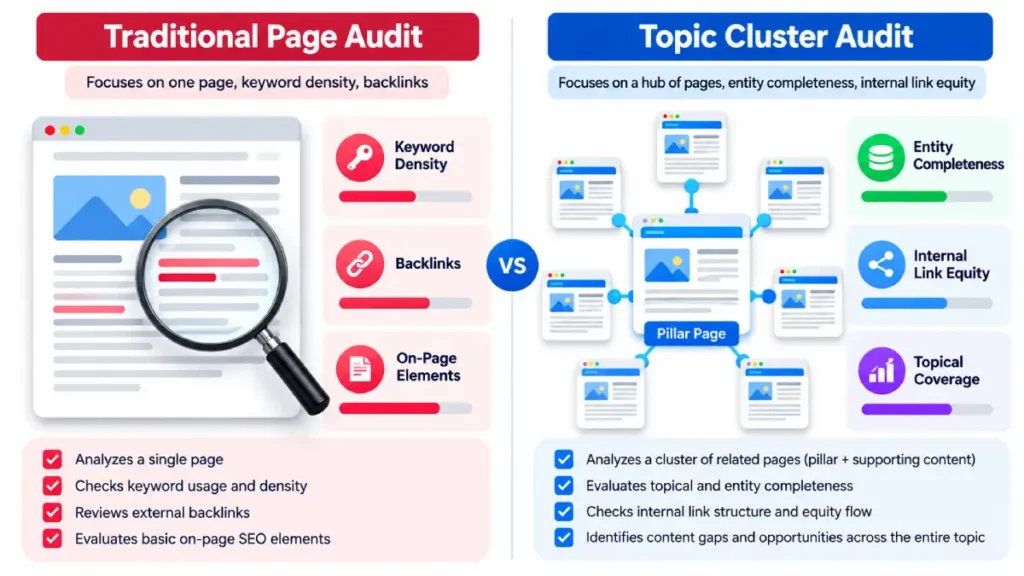
A successful evaluation of your content ecosystem requires moving beyond surface-level traffic metrics. You must dismantle and inspect the cluster based on three fundamental pillars.
1. Entity and Semantic Completeness
To prove topical authority, a cluster must reflect the relationships found in established knowledge bases. An audit maps your existing content against these known entities.
If your cluster comprehensively covers “Coffee Roasting” but completely omits the “Maillard Reaction” or “First Crack,” it suffers from a semantic gap.
Modern audits utilize entity gap mapping, which compares a site’s cluster directly against Wikidata’s relationship graph. This disambiguation step calculates a topical completeness score—the share of expected entities your cluster actually mentions.
Missing central entities signal to both human readers and AI systems that the content is thin, preventing the cluster from being recognized as a definitive source.
2. Internal Link Architecture Integrity
Links are the neural pathways that signal relevance and hierarchy. A cluster audit meticulously examines the bidirectional relationship between the pillar and the spoke pages.
Are there orphaned cluster pages? Does the pillar link to every supporting document? Do the spoke pages link back to the pillar using optimized, varied anchor text?
Evaluating these internal linking frameworks ensures link equity flows efficiently through the network rather than pooling in dead ends. A properly wired cluster mathematically distributes PageRank, lifting the visibility of long-tail subtopics alongside the highly competitive pillar term.
3. Intent Overlap and Cannibalization Analysis
As clusters grow, they inevitably bloat. A common symptom of an unchecked cluster is having multiple spoke pages targeting the same granular search intent (e.g., a page for “Best CRM for Small Business” and another for “Top CRMs for Small Companies”).
A rigorous audit identifies these overlapping nodes so they can be merged or canonicalized. This concentrates ranking signals into a single, highly authoritative page rather than diluting them across multiple mediocre assets.
Step-by-Step Topic Cluster Audit Workflow
Executing a topic cluster audit requires a methodical approach to data extraction and semantic analysis. Follow this step-by-step workflow to identify actionable growth opportunities.
Phase 1: Cluster Inventory and URL Mapping
Begin by exporting all indexed URLs using your preferred crawler and categorizing them by their assigned cluster. Do not rely on URL slug structures alone; map them by their semantic relationship to the pillar.
Extract the internal outlinks of your pillar pages to visually map the current architecture. This initial inventory highlights orphaned pages that belong in the cluster but lack the necessary internal connections to prove it.
Phase 2: Entity Gap Analysis
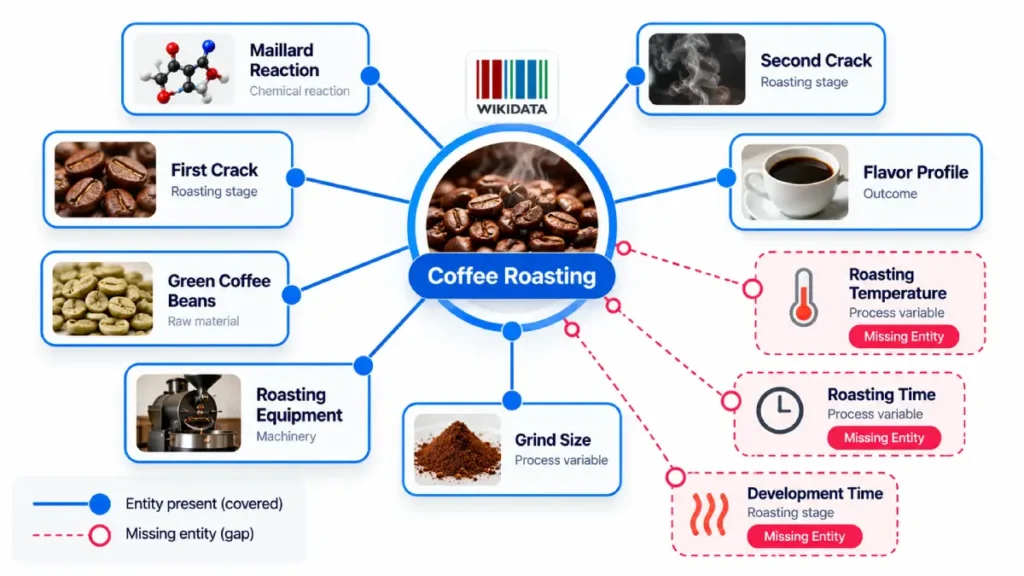
Once the inventory is mapped, compare the combined text of your entire cluster against an external knowledge graph. Utilize NLP APIs or entity gap tools to highlight which highly related concepts are missing.
This step reveals the “Topic Gaps” and “Content Depth Gaps.” For instance, if your pillar is about “Shopify Store Development” but you lack a dedicated spoke page for “Shopify Development Costs,” you have an entity gap that competitors are likely exploiting.
Phase 3: Performance and Journey Evaluation
Pull query data from Google Search Console for the entire cluster. Look for queries where multiple URLs are generating impressions but failing to secure top positions—a primary indicator of cannibalization.
Furthermore, evaluate the user journey. High pages-per-session within a specific cluster indicates that users are naturally navigating from the pillar to the spokes, confirming the cluster’s relevance.
Conversely, high bounce rates on spoke pages might suggest a format gap; perhaps the user required a downloadable template or a video tutorial, rather than a wall of text.
Phase 4: Pruning, Consolidating, and Expanding
The final phase translates your findings into a prioritized action plan, a mandatory component of comprehensive SEO diagnostic deliverables. Your audit should result in three specific directives:
- Prune and Consolidate: Merge thin, overlapping cluster pages into a single authoritative document and implement 301 redirects to preserve link equity.
- Expand: Commission new spoke pages to fill the identified entity and intent gaps, ensuring they cover the missing knowledge graph nodes.
- Re-wire: Fix broken, missing, or exact-match heavy internal links to establish a flawless structural baseline for topical authority.
Integrating the Audit with AI Overviews (SGE)
As search engines shift toward generative AI features, the demands on topic clusters have evolved significantly. AI systems do not merely scrape isolated facts; they synthesize interconnected concepts.
A cluster that thoroughly maps out entity relationships provides AI models with the necessary surface area to generate comprehensive answers.
An audited, entity-complete cluster is significantly more likely to be cited in AI Overviews because it proves the website is a definitive, structurally sound ecosystem of information, rather than a fragmented collection of keywords.
Regular auditing guarantees that your architecture remains tightly woven, contextually rich, and permanently aligned with user intent.