

A successful link spam fix requires a systematic audit of your website’s backlink profile to isolate manipulative links—both inbound and outbound—and neutralize them to regain search engine trust.
When Google deployed SpamBrain during the December 2022 link spam update, the algorithm shifted from merely penalizing offending domains to completely nullifying the ranking credit of unnatural links.
Because subsequent rollouts, including the June 2024 and August 2025 spam updates, aggressively targeted link schemes and scaled network abuse, a modern link spam fix demands more than just blindly uploading a disavow file.
It involves removing toxic paid placements, applying rel="sponsored" attributes to affiliate outbound links, securing user-generated content from spam injections, and accepting that “recovery” means replacing lost artificial link equity with high-quality, intent-driven digital PR.
For SEO professionals, treating the root cause of algorithmic depreciation rather than the symptoms is the only definitive path to restoring long-term search visibility.
Understanding SpamBrain and the End of Link Equity
Historically, Google handled link spam through manual actions or the Penguin algorithm, which demoted sites engaged in obvious keyword-rich anchor text manipulation.
Today, SpamBrain—Google’s AI-based spam prevention system—operates with significantly higher precision. It identifies not just the sites buying links, but the underlying network of sites built explicitly to pass outgoing ranking credit.
When an algorithmic spam update rolls out, SpamBrain essentially turns off the faucet. The inbound links that previously artificially inflated a site’s PageRank are neutralized instantly across all languages globally.
Why You Can’t “Recover” Neutralized Links
A critical shift for SEOs to understand is that algorithmic link spam neutralization is permanent. Google has explicitly stated that the benefits from neutralized links cannot be regained.
If a website loses 30% of its organic traffic following a spam update, simply removing or disavowing the bad links will not restore the traffic because those links are now mathematically worthless in Google’s graph.
A true link spam fix requires identifying the deficit left by nullified links and bridging that gap with legitimate, earned authority.
As recent large-scale studies demonstrate, over 96% of indexed pages with zero backlinks receive no organic traffic, underscoring the absolute necessity of a healthy, authoritative link profile.
Diagnosing Inbound vs. Outbound Link Spam
Before initiating a technical fix, SEO professionals must pinpoint the vulnerability. Link spam falls into two categories, each requiring a different tactical response.
Inbound Link Vulnerabilities
Inbound spam involves external websites pointing manipulative links at your domain. Strong algorithmic indicators include:
- Sudden spikes in referring domains from irrelevant country-code top-level domains (ccTLDs).
- A highly concentrated anchor text ratio utilizing exact-match commercial keywords rather than branded or naked URLs.
- Links originating from expired domain networks or low-tier private blog networks (PBNs).
Outbound Link Vulnerabilities
Often overlooked, outbound link spam occurs when your website leaks authority to manipulative destinations. This triggers algorithmic devaluation because your site is classified as an active participant in a link scheme. Common culprits include:
- Unmoderated user-generated content (UGC) in comment sections or forums.
- Guest posts containing exact-match anchor text pointing to commercial landing pages.
- Affiliate links lacking the mandatory
rel="sponsored"orrel="nofollow"attributes. - Hidden links injected via compromised plugins or security vulnerabilities.
To ensure your broader site architecture isn’t enabling these vulnerabilities, reviewing your overall structural hierarchy via our complete structural indexing repository can reveal orphaned pages that are highly susceptible to hidden spam injections.
The 4-Step Link Spam Fix Protocol
Implementing a link spam fix requires clinical precision. Removing benign links by mistake can further degrade your organic visibility.
Step 1: Execute a Backlink Profile Audit
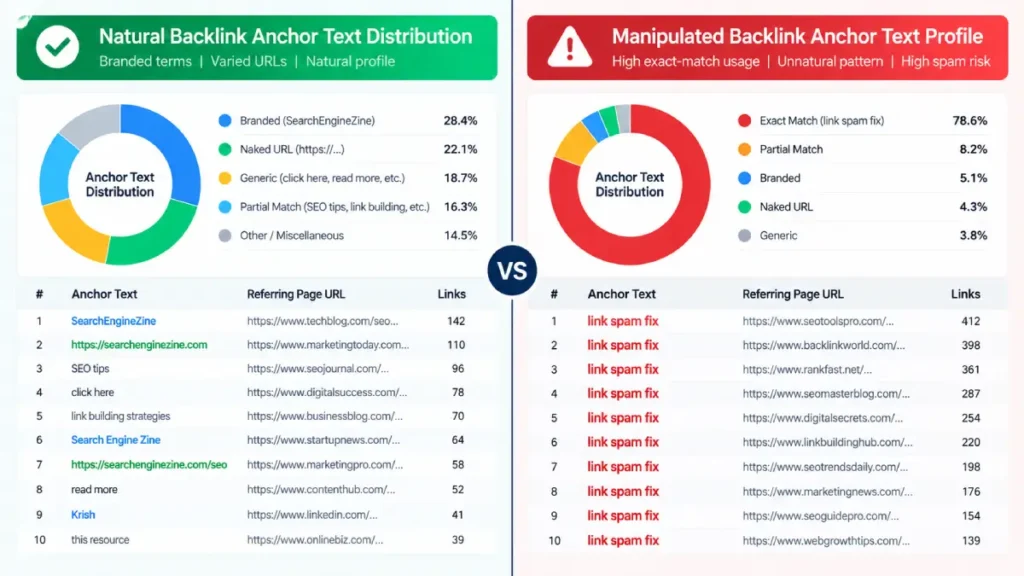
Export your backlink profile from Google Search Console (combining “Latest links” and “More sample links”) and cross-reference it with commercial crawlers like Ahrefs, Majestic, or Semrush. Sort the referring domains by toxicity signals and anchor text exact-match frequency.
Do not rely solely on third-party “Toxic Score” metrics, as these are proprietary models that frequently flag false positives. Instead, manually review the highest-velocity link acquisitions.
Look for programmatic footprints: identical C-class IP addresses, boilerplate WordPress theme designs across multiple referring domains, duplicate WHOIS registration data, and referring pages devoid of any contextual internal linking or independent organic traffic.
Step 2: Cleanse Outbound Link Violations
Before addressing inbound links, secure your own domain.
- Audit UGC: Implement robust auto-moderation for comments and ensure all user-generated links default to
rel="ugc". - Tag Paid Links: Crawl your site for affiliate links, advertorials, and sponsored placements. Hardcode the
rel="sponsored"tag on every commercial outbound link to remain compliant with Google’s spam policies. - Security Sweep: Run a server-side malware scan to detect hidden outbound links injected by bad actors—a common tactic in pharmaceutical and casino SEO attacks.
Step 3: Targeted Link Removal Outreach
If your domain has received a Manual Action for unnatural links, Google requires a good-faith effort to remove the spam manually. Identify the webmasters of the offending domains and request link removal.
Document every outreach attempt, including dates and email addresses, as this log is mandatory evidence for your reconsideration request. For purely algorithmic hits, manual outreach is largely a waste of resources, as SpamBrain has already neutralized the credit on the backend.
Step 4: Surgical Use of the Disavow Tool
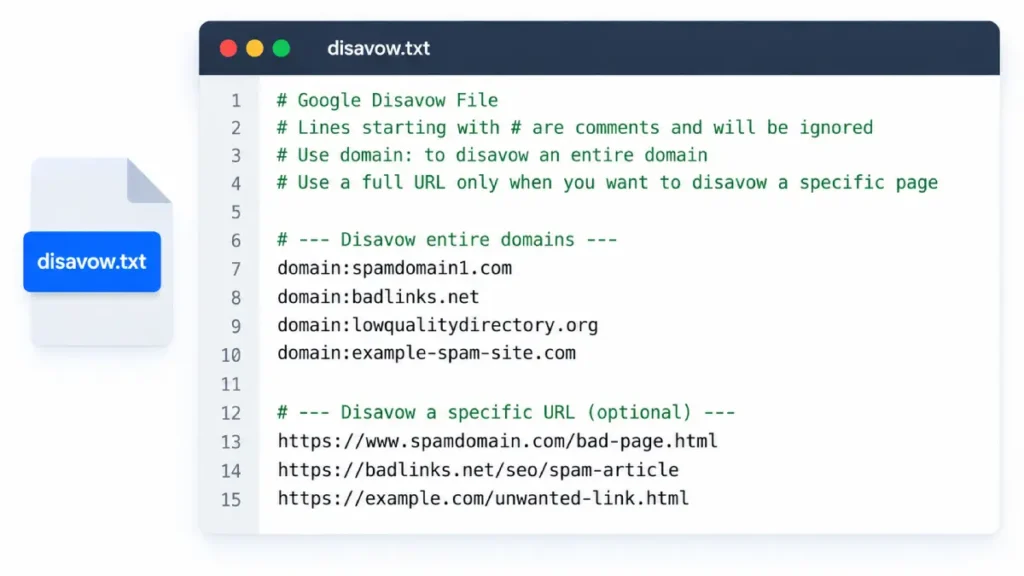
The Disavow Tool is highly misunderstood in modern search environments. Because SpamBrain natively ignores algorithmic spam at the point of discovery, uploading a massive disavow file for a standard algorithmic traffic drop is generally unnecessary—and potentially harmful if you accidentally sever ties with legitimate, equity-passing links.
You should only utilize the Disavow Tool if:
- You have an active Manual Action for “Unnatural links to your site” in Google Search Console.
- You are the target of a severe, sustained negative SEO attack with a clear, programmatic footprint.
- You are proactively cleansing a purchased expired domain that contains a heavily manipulated historical backlink profile.
When formatting the .txt file, utilize the domain: operator to block entire toxic domains rather than individual URLs, ensuring maximum coverage against sprawling PBNs.
Establishing a Post-Fix Authority Strategy
Once the link spam fix is deployed and your backlink profile is sanitized, the focus must shift entirely to legitimate acquisition. A domain recovering from a link spam update is operating at a structural authority deficit.
Invest heavily in data-driven digital PR and asset-led link building. Create high-density, original research that naturally attracts citations from authoritative journalists and industry publications.
While the algorithmic penalty may be lifted, search visibility will only return when the neutralized spam is replaced by genuine signals of discovery and trust.