

Synthetic financial data is artificially generated tabular, transactional, or time-series information created by statistical models, generative adversarial networks (GANs), variational autoencoders (VAEs), or diffusion architectures to mimic the mathematical properties of real financial records without exposing personally identifiable information (PII) or proprietary corporate metrics.
For SEO professionals working in fintech, banking, wealth management, and B2B financial SaaS, understanding synthetic financial data serves two distinct purposes: optimizing content and programmatic SEO hubs around an increasingly searched enterprise topic, and utilizing synthetic datasets to safely model conversion funnels, revenue attribution, and organic traffic forecasting without violating data privacy mandates.
As financial institutions tighten data governance under frameworks like the Gramm-Leach-Bliley Act (GLBA), the General Data Protection Regulation (GDPR), and the California Consumer Privacy Act (CCPA), marketing and SEO teams rarely receive direct access to raw production databases.
Synthetic data bridges this gap by offering statistically representative sandboxes while creating a high-intent topical vertical that requires rigorous editorial governance to satisfy Google’s E-E-A-T (Experience, Expertise, Authoritativeness, and Trustworthiness) standards. Connect synthetic data validation to our Enterprise AI Data Auditing framework.
Why Synthetic Financial Data Matters in Search and SEO Operations
In the United States financial sector, search demand surrounding synthetic data spans technical engineering queries (such as generating synthetic credit card transaction datasets for fraud detection) and executive compliance queries (such as using synthetic records for cross-border cloud analytics). For SEO strategists managing financial domains, this topic intersects with search operations in three primary ways.
1. High-Intent B2B and Fintech Content Capture
Enterprise buyers searching for synthetic financial data solutions typically exhibit high commercial intent. Decision-makers in risk management, machine learning engineering, and regulatory compliance search for specific capabilities—such as differential privacy guarantees, referential integrity across multi-table relational schemas, and statistical fidelity benchmarks. Content targeting these queries must go beyond surface-level definitions to address technical validation methods, regulatory alignment, and deployment trade-offs.
2. Privacy-Safe SEO Attribution and Funnel Modeling
SEO teams operating in Your Money or Your Life (YMYL) verticals frequently struggle to connect organic landing page performance to downstream financial outcomes—such as approved loan applications, funded brokerage accounts, or enterprise contract values—because compliance teams restrict PII sharing between CRM platforms and analytics environments. By generating synthetic cohorts that preserve the statistical correlations between organic search entry points, user demographics, and conversion probabilities, SEO analysts can build attribution models and test forecasting scenarios in external business intelligence tools without exposing real customer records.
3. Safe Staging and Programmatic Template Testing
Financial publishers and comparison marketplaces often deploy programmatic SEO pages covering mortgage rates, credit card yields, or localized banking products. Testing complex schema markup, dynamic calculators, and database-driven templates in staging environments using real customer portfolios creates unnecessary security exposure. Synthetic financial datasets allow engineering and technical SEO teams to stress-test page rendering, structured data validation, and crawl behavior at scale using realistic numerical distributions.
How Synthetic Financial Data Is Generated
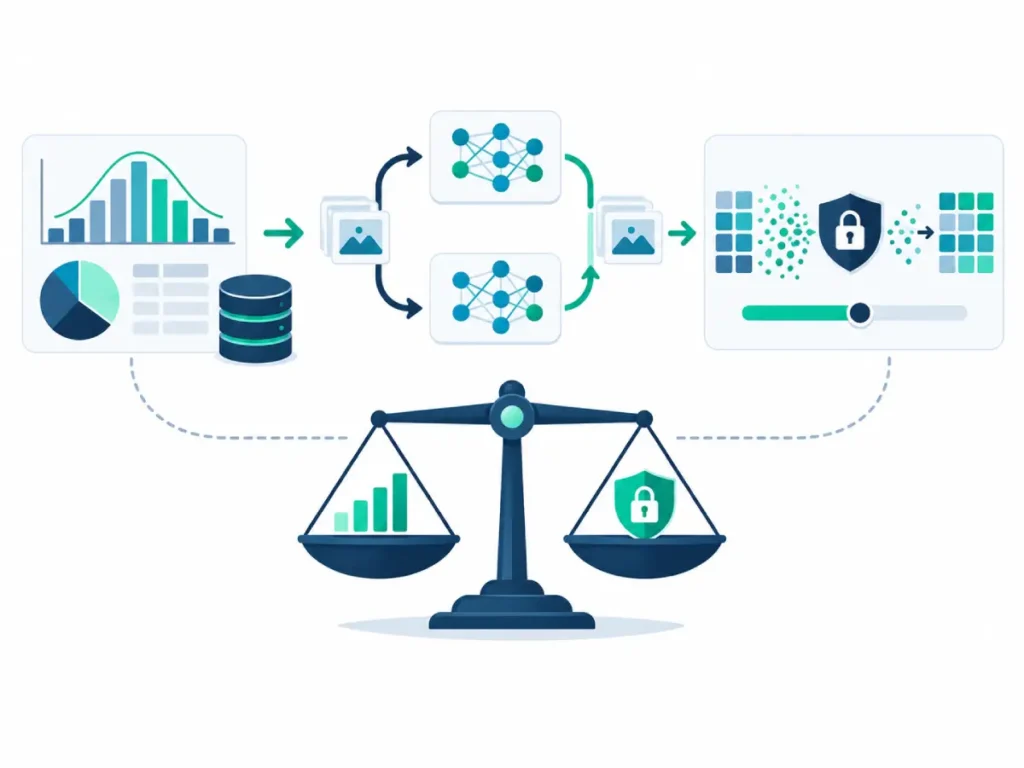
Not all synthetic data carries the same statistical utility or privacy profile. SEO strategists creating technical content or evaluating datasets for internal analytics should distinguish between three primary generation paradigms.
| Generation Method | Core Mechanism | Best Financial Use Cases | Key Limitations |
| Rule-Based & Statistical Simulation | Uses deterministic rules, Monte Carlo simulations, or copula models to sample from known probability distributions. | Stress-testing financial calculators, basic funnel modeling, and baseline schema QA. | Fails to capture complex, non-linear correlations across high-dimensional transaction histories. |
| Deep Generative Models (GANs & VAEs) | Neural networks learn latent representations of real tabular or sequential data to synthesize realistic records. | Fraud detection training, credit risk modeling, and multi-variable customer journey simulation. | Prone to mode collapse (missing rare edge cases) and potential memorization of outlier records. |
| Differentially Private Synthesis | Injects calibrated mathematical noise during model training to guarantee that individual records cannot be reverse-engineered. | Sharing datasets across third-party vendors, cross-border analytics, and public benchmark releases. | Stronger privacy budgets ($\epsilon$) reduce statistical accuracy and distort tail-end financial events. |
Tabular vs. Sequential Time-Series Financial Data
Financial records rarely exist as isolated rows. A checking account ledger, an equities order book, or a multi-touch B2B SaaS billing cycle depends on temporal order and relational integrity. Standard tabular generators often shuffle row independence, breaking chronological patterns such as payday deposit spikes followed by recurring bill payments. Advanced sequential models—such as autoregressive transformers or specialized time-series GANs—preserve temporal dependencies, making them essential when modeling customer lifetime value (LTV) or seasonal search-to-conversion lags.
Navigating Google’s YMYL and E-E-A-T Standards for Synthetic Data Content
Because financial topics fall squarely under Google’s YMYL classification, publishing content about synthetic financial data—or publishing data-driven studies built on synthetic datasets—requires strict editorial transparency. Search quality evaluators assess whether financial content demonstrates verifiable expertise, clear sourcing, and an absence of deceptive claims.
Rules for Publishing Studies Using Synthetic Datasets
SEO campaigns frequently rely on “digital PR” data studies to earn editorial backlinks. In finance, publishing a study based on real customer data is often legally impossible, tempting marketers to generate synthetic datasets instead. If your organization uses synthetic financial data to illustrate market trends or model consumer scenarios:
- Disclose the methodology explicitly: State clearly in the methodology section that the figures represent modeled or synthetic simulations rather than empirical customer records. Presenting synthetic outputs as real-world observational data violates editorial trust and risks manual actions or reputational damage.
- Anchor models to public benchmarks: Calibrate synthetic distributions against verified public datasets, such as Federal Reserve economic data (FRED), Consumer Financial Protection Bureau (CFPB) complaint databases, or FDIC quarterly banking profiles.
- Avoid false precision: When reporting synthetic projections, present ranges and confidence intervals rather than exact point estimates that imply direct measurement.
Avoiding AI-Generated Content Pitfalls
There is an important distinction between using synthetic financial data as a subject or analytical tool and mass-producing low-value, unreviewed AI-generated articles.
While Google’s guidance on AI-generated content focuses on content helpfulness rather than production method, financial pages lacking human subject-matter review, verifiable citations, and clear authorship consistently underperform in competitive SERPs.
Audit training data compliance and synthetic datasets via our LLM data compliance guide and synthetic data generation guide.
Technical articles covering synthetic data architectures should be reviewed or co-authored by data scientists, compliance officers, or quantitative analysts.
Practical SEO Content Strategy for the Synthetic Financial Data Niche

To capture search demand across the buyer journey without triggering keyword cannibalization, structure content into distinct topical tiers aligned with user intent.
Tier 1: Foundational and Compliance-Focused Guides (Informational Intent)
Target broad queries from compliance officers, risk managers, and product leaders evaluating whether synthetic data meets regulatory standards.
- Core topics: How synthetic financial data satisfies GDPR anonymization recitals, distinctions between data masking, tokenization, and synthetic generation, and vendor evaluation checklists.
- Content elements: Side-by-side comparison tables, regulatory framework mappings, and clear definitions of privacy metrics like $k$-anonymity and differential privacy ($\epsilon$).
Tier 2: Technical Implementation and Benchmarking (Commercial Investigation Intent)
Target data engineers and ML architects comparing open-source libraries against enterprise synthetic data platforms.
- Core topics: Preserving referential integrity across primary and foreign keys in core banking schemas, evaluating statistical fidelity using Wasserstein distance or Kolmogorov-Smirnov tests, and handling imbalanced fraud datasets.
- Content elements: Architecture diagrams, evaluation rubrics, and reproducible benchmarking frameworks.
Tier 3: Use-Case Specific Landing Pages (Transactional Intent)
Target vertical-specific buyers seeking turnkey solutions for defined workflows.
- Core topics: Synthetic data for anti-money laundering (AML) model tuning, cloud migration testing for legacy banking cores, and third-party vendor sandbox provisioning.
- Content elements: Specific compliance certifications (SOC 2 Type II, ISO 27001), deployment models (on-premises vs. VPC), and integration specifications.
Evaluating Synthetic Financial Data Quality: A Checklist for Data and SEO Teams
Whether evaluating a synthetic dataset for internal marketing attribution or reviewing technical accuracy for a client’s whitepaper, assess quality across three dimensions:
- Statistical Fidelity (Utility): Does the synthetic dataset preserve univariate distributions (mean, variance, skewness) as well as multivariate correlations (e.g., the relationship between credit utilization, debt-to-income ratio, and default probability)?
- Privacy Preservation (Resilience): Has the dataset been tested against membership inference attacks (determining whether a specific real individual was in the training set) and attribute inference attacks (predicting sensitive fields from non-sensitive attributes)?
- Operational Realism (Schema Compliance): Do generated fields adhere to domain constraints—such as valid ISO currency codes, non-negative account balances where required, accurate Luhn checksums for test payment cards, and chronological consistency between account opening dates and transaction timestamps?
Risks and Limitations to Address Candidly
A credible editorial strategy around synthetic financial data must acknowledge its limitations rather than framing it as a frictionless silver bullet:
- Outlier Suppression and Tail Risk: Financial crises, market crashes, and novel fraud vectors occur in the extreme tails of probability distributions. Because generative models optimize for common patterns, they frequently smooth out rare anomalies—precisely the events financial risk models need to detect.
- Feedback Loops and Model Collapse: Training successive generations of financial models on synthetic outputs without grounding in fresh empirical data degrades variance and amplifies systematic biases over time.
- Regulatory Ambiguity: While regulators increasingly recognize privacy-enhancing technologies (PETs), synthetic data is not automatically exempt from privacy statutes. If a poorly calibrated model memorizes and reproduces real customer records, regulators treat the output as personal data subject to full statutory penalties.
Actionable Next Steps for SEO Teams
- Audit existing fintech and analytics content: Identify pages discussing data privacy, financial modeling, or AI in banking that lack depth on synthetic data workflows or fail to distinguish between anonymization and synthetic generation.
- Establish disclosure standards for data-driven PR: Create an editorial policy requiring explicit methodology disclosures whenever modeled or synthetic figures are used in research reports, interactive calculators, or industry benchmarks.
- Collaborate with data governance teams: Request privacy-safe synthetic cohorts for organic funnel modeling so SEO reporting can incorporate downstream revenue quality without exposing customer PII.
- Build intent-segregated topic clusters: Separate high-level regulatory explainers from technical architecture guides and vertical use-case pages to prevent internal keyword overlap and capture qualified search traffic across every stage of enterprise evaluation.
- Strengthen privacy safeguards and retrieval validation through our differential privacy AI guide and RAG data validation guide.