
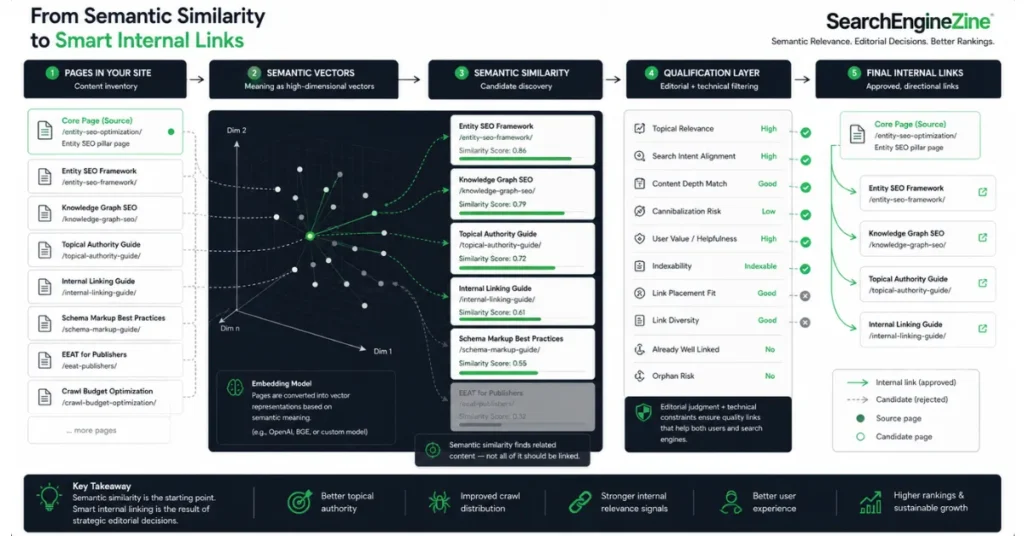
Internal link vectoring uses text embeddings and vector similarity to identify semantically related pages that may represent internal-link opportunities.
Instead of relying only on shared keywords, the method represents pages or passages numerically and compares them for semantic relatedness. Embeddings can be used to measure how closely pieces of text relate, including through cosine similarity.
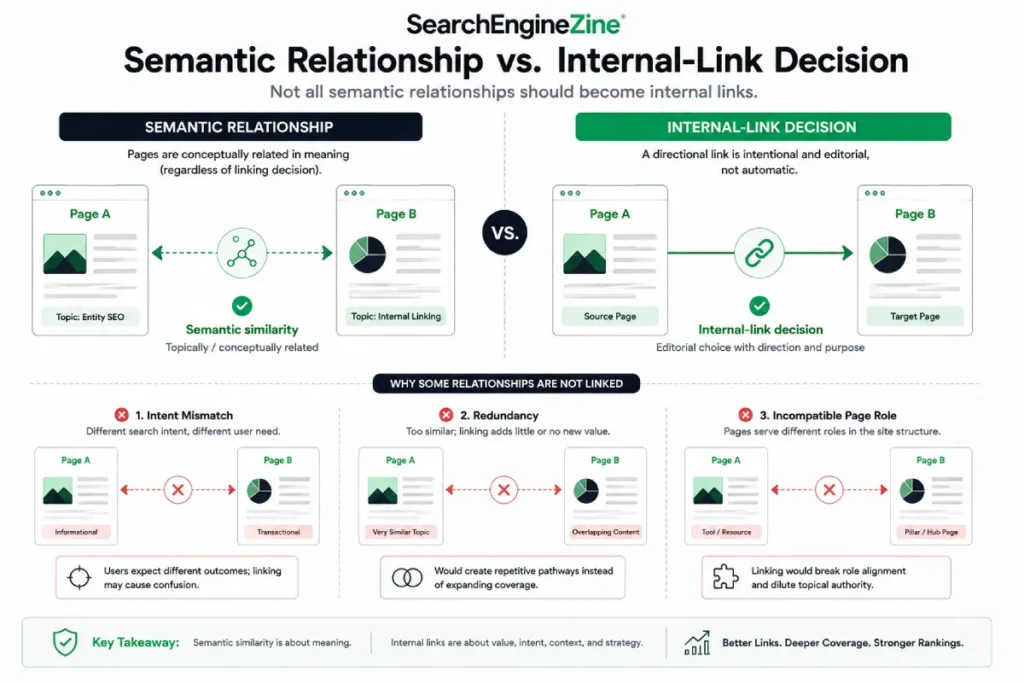
The critical distinction is that similarity identifies candidates; it does not decide whether a link should exist.
A useful internal-link decision also considers search intent, page role, contextual relevance, existing links, redundancy, and link direction.
Used correctly, it becomes a candidate-discovery layer for internal-link strategy.
What Internal Link Vectoring Actually Does
Traditional internal-link discovery often begins with keyword matching. An SEO searches a site for pages containing a phrase and then evaluates whether those pages should be connected.
Vector-based discovery approaches the problem differently:
Page content → embedding → vector representation → similarity comparison → candidate relationship
An embedding represents text numerically so that semantic relationships can be compared. Cosine similarity is one common method for comparing embedding vectors.
This can uncover relationships that are not obvious from exact wording alone.
| Page A | Page B | Lexical relationship | Potential semantic relationship |
|---|---|---|---|
| How Google Crawls JavaScript | JavaScript Rendering in Search | Moderate | Strong |
| Canonical URL Best Practices | Duplicate Content and Canonicalization | Moderate | Strong |
| Keyword Intent Mapping | Search Intent Classification | Moderate | Strong |
The important point is that semantic similarity expands the candidate pool; it does not replace editorial judgment.
For broader context on organizing content, internal relationships, and on-page architecture, see SearchEngineZine’s On-Page Strategy.
How Vector-Based Link Discovery Works
A practical system can be reduced to five stages.
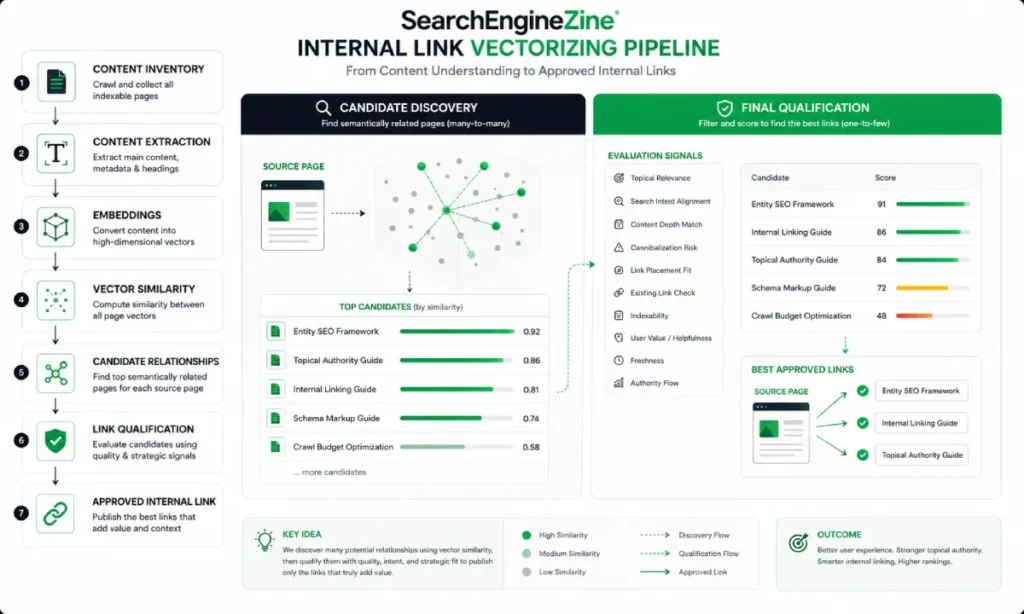
1. Build the content inventory
Collect the pages to be analyzed and extract meaningful textual content.
Boilerplate, navigation, repeated templates, cookie notices, and unrelated page elements can distort the representation, so content extraction is an important part of the workflow.
2. Generate embeddings
Convert each page or selected passage into an embedding.
Page-level embeddings can provide a useful first-pass relationship map. Passage-level embeddings can provide greater precision when the goal is to identify the specific context in which a link might belong.
Dense Passage Retrieval research demonstrates that dense representations can be effective for semantic retrieval tasks. That research should not, however, be interpreted as evidence that embeddings themselves improve Google rankings.
3. Compare vectors
A common similarity calculation is:
[
\text{cosine similarity}(A,B)=
\frac{A\cdot B}{|A||B|}
]
The resulting scores can rank potentially related pages or passages. OpenAI explains that its embedding outputs are normalized and that cosine similarity can therefore be computed efficiently using a dot product.
4. Remove existing relationships
Compare the candidate pairs against the site’s current internal-link graph.
There is little value in repeatedly rediscovering links that already exist. The system should focus attention on missing or potentially stronger relationships.
5. Qualify the candidates
This is the most important stage.
A vector system may identify:
Page A ↔ Page B = highly related
The SEO still needs to ask:
Should Page A link to Page B?
Those are different questions.
Why Semantic Similarity Is Not Enough
Similarity is generally symmetric: if two representations are highly similar, the relationship exists in both directions.
An internal link is directional:
Page A → Page B
The reverse link may be unnecessary.
Therefore, a similarity score alone cannot determine the correct linking relationship.
| Vector relationship | SEO interpretation | Action |
|---|---|---|
| High similarity + complementary intent | Strong contextual relationship | Evaluate as a link candidate |
| High similarity + nearly identical intent | Possible redundancy | Investigate first |
| Moderate similarity + strong user-journey connection | Useful supporting relationship | Evaluate as a link candidate |
| High similarity + incompatible page role | Related but strategically weak | Reject |
Consider a page explaining canonical tags and another explaining duplicate content. Their semantic relationship may be strong, but the correct linking decision depends on the information each page provides and what the reader needs next.
Similarly, extremely high similarity can sometimes signal excessive topical overlap rather than an obvious linking opportunity.
Google documents that links help it find new pages and understand the relevance of pages, while descriptive anchor text helps users and Google understand the destination. It also states that there is no magical ideal number of links for a page. Google Search Central: Link Best Practices
A Better Framework for Qualifying Link Opportunities
The strongest way to use vectoring is to place a Link Qualification Layer between similarity detection and link insertion:
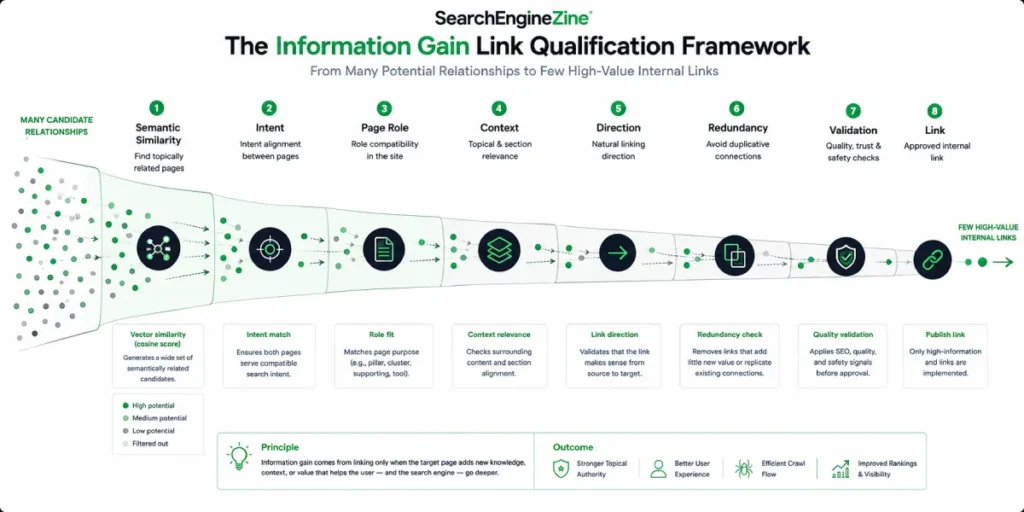
Semantic similarity → Intent compatibility → Page-role compatibility → Contextual fit → Link direction → Redundancy check → Validation → Link
1. Semantic similarity
First ask:
Are the two pieces of content genuinely related?
This is the part embeddings are designed to help answer.
2. Search-intent compatibility
Next ask:
Do the two pages serve compatible user needs?
A page answering “what is canonicalization?” may naturally support a page explaining “how to implement canonical tags.” Two pages targeting essentially the same question require a different evaluation.
For deeper context on intent mapping and content relationships, see SearchEngineZine’s Keyword Research Framework.
3. Page-role compatibility
Determine each page’s role within the information architecture.
Useful relationships can include:
- hub → supporting article;
- explanatory article → implementation guide;
- broad topic → narrower concept;
- problem → solution;
- prerequisite → advanced resource.
For additional context on hub-and-cluster relationships, see SearchEngineZine’s Topic Cluster Model.
4. Contextual fit
Ask:
Can the source page naturally introduce the destination?
Google recommends descriptive and relevant anchor text and explains that the words surrounding a link also provide context.
A high similarity score is not enough if there is no natural point in the source content where the destination helps the reader.
5. Link direction
Ask:
Which page should link to which?
The direction should follow the user’s information journey rather than simply mirroring the similarity relationship.
6. Redundancy check
Ask:
Does the destination add information, or does it merely repeat what the reader already has?
This is particularly important when vectoring identifies very similar documents.
7. Validation
Finally, review the candidate before publication.
The goal is not to maximize generated links.
The goal is to maximize the number of useful links accepted.
For deeper context on information gain and differentiated content, see SearchEngineZine’s Information Gain SEO Framework. That framework should be treated as SearchEngineZine’s editorial methodology rather than as a Google-defined metric.
Where Vector Linking Can Fail
Vector-based discovery can produce false positives or misleading priorities.
| Failure condition | Why it happens | Better response |
|---|---|---|
| Near-duplicate pages | Similarity correctly detects overlap | Investigate differentiation or consolidation |
| Different search intents | Same subject, different user task | Evaluate intent before linking |
| Template-heavy pages | Repeated boilerplate affects representations | Clean content before embedding |
| Very short pages | Limited semantic signal | Treat scores cautiously |
| One universal threshold | Candidate distributions vary | Calibrate against the actual dataset |
| Excessive automation | High-score pairs become automatic links | Add qualification and review |
| Existing link already present | Candidate discovery ignores the current graph | Filter existing relationships |
| Related but strategically irrelevant pages | Topic overlap does not guarantee user value | Reject the candidate |
There is no authoritative basis for treating one cosine-similarity value as a universal SEO threshold.
A threshold is a candidate-filtering parameter, not a Google ranking rule.
How to Use Vector Scores Without Over-Automating
The safest division of labor is:
Automate discovery.
Assist prioritization.
Review the final link.
A useful candidate record can contain:
- source URL;
- destination URL;
- similarity score;
- source topic;
- destination topic;
- intent relationship;
- existing-link status;
- suggested contextual location;
- validation status.
The SEO can then determine whether the relationship deserves implementation.
This approach also aligns with Google’s documented guidance: important pages should be reachable through internal links, and links should use descriptive, relevant anchor text rather than generic or keyword-stuffed wording.
What to Measure After Implementation
Do not evaluate a vector-linking system only by the number of opportunities it generates.
Measure the quality of the opportunities.
Useful operational measurements include:
- candidate opportunities generated;
- candidates accepted after review;
- false-positive rate;
- existing-link coverage;
- links rejected for intent mismatch;
- links rejected for redundancy;
- contextual quality of accepted links;
- changes observed after controlled implementation.
One useful diagnostic ratio is:
Accepted useful links ÷ total candidate links
A system generating 10,000 semantically related pairs is not necessarily better than one generating 1,000 candidates if the larger set contains substantially more irrelevant or redundant relationships.
The objective is better information flow through the site, not a larger link count.
Conclusion
Internal link vectoring is best understood as a semantic discovery layer for internal-link analysis.
Embeddings can help identify relationships that keyword matching may miss, while vector similarity can rank those relationships efficiently. Dense-retrieval research supports the use of dense representations for retrieval tasks, but it does not establish vector similarity as a Google ranking factor.
The stronger model is:
Vector similarity → candidate discovery → intent validation → architectural validation → contextual validation → directional decision → human review → internal link
Vector technology can tell you which pages are related.
A strong SEO system must still determine which relationships are useful to users and worth turning into links.