
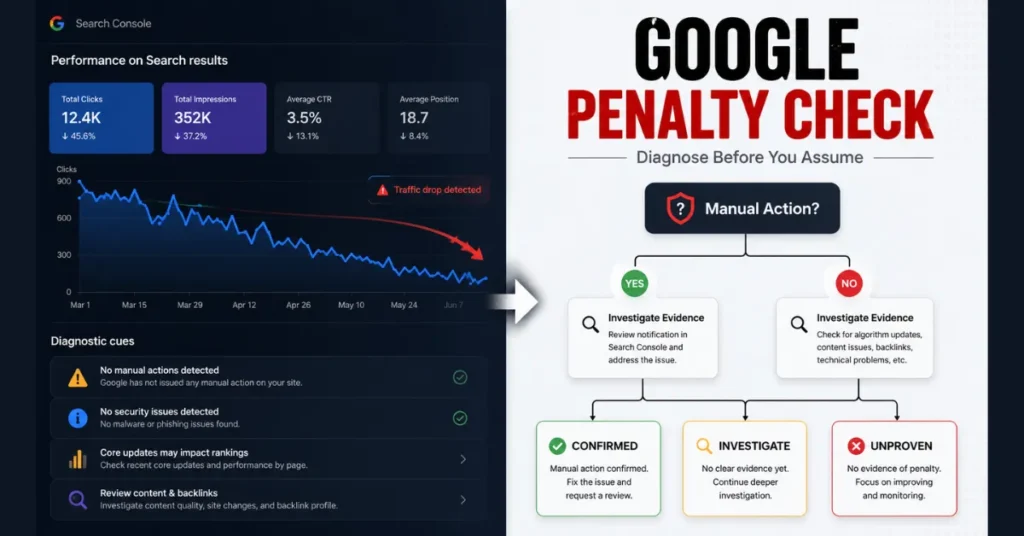
A Google Penalty Check in SEO starts with Google Search Console’s Manual Actions report. If your Google traffic or rankings suddenly fall, check this report first to determine whether Google has issued a manual action.
If one exists, Search Console identifies the issue and shows the affected page patterns. Google defines a manual action as an action taken after a human reviewer determines that pages on a site do not comply with its spam policies, as documented in the Manual Actions report
However, a traffic drop is not, by itself, proof of a Google penalty. If the Manual Actions report is clear, investigate other possible causes including ranking-system changes, technical or indexing problems, changing search demand, and site migrations before concluding that your site has been penalized.
The practical sequence is:
Check Manual Actions → check for data/system issues → investigate the decline → test competing explanations → assess the evidence → act.
This is stronger for SEO because “Google Penalty Check in SEO” appears immediately, while the first sentence still gives the reader a meaningful answer rather than simply inserting the keyword mechanically.
How to Check for a Google Manual Action
Google Search Console provides the most direct check for a confirmed manual action.
- Open the Manual Actions report for your verified property.
- Check whether an active manual action is listed.
- Expand the issue to see the violation and affected page patterns.
- Fix the underlying issue across all affected pages.
- When the listed problems have been fixed, select Request Review and explain the changes you made.
A manual action may affect part of a site or the entire site. Google notes that the affected-page patterns shown in the report do not necessarily mean every page matching that pattern is affected.
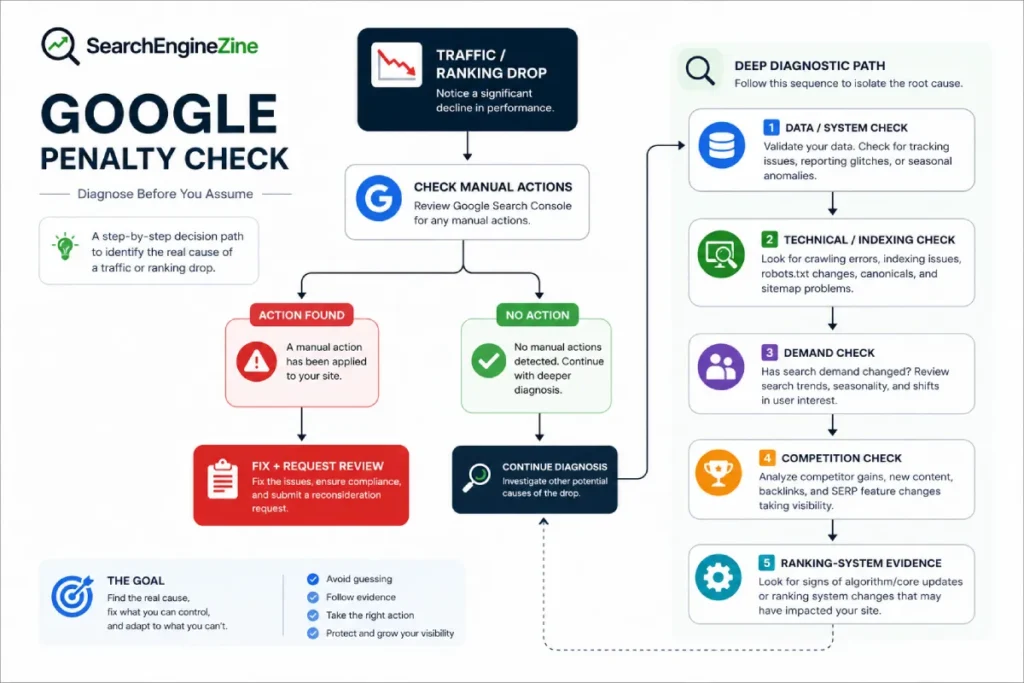
If the report shows no manual action, you have established something important, but you have not diagnosed the reason for a traffic decline.
For broader analysis of Search Console performance data, SearchEngineZine’s SEO Data Analytics framework can serve as a supporting resource.
No Manual Action? Don’t Assume the Traffic Drop Is Explained
This is where the term “Google penalty” can become misleading.
A manual action is a specific Google enforcement action related to violations of Google’s spam policies.
A ranking or traffic decline can have other causes, including changes to Google’s ranking systems or problems with the site itself.
Google’s current traffic-drop documentation recommends investigating several possible causes rather than assuming one explanation, including technical problems and security issues; Google provides a separate Security Issues report for sites that may have been hacked or otherwise compromised.
Use this distinction:
| Finding | What you can conclude |
|---|---|
| Manual action reported | Google has confirmed a manual enforcement issue |
| No manual action + traffic decline | The cause is still undetermined |
| No manual action + decline coinciding with an update | The update is a hypothesis worth investigating, not proof of a penalty |
That distinction prevents a common diagnostic error: treating every significant ranking loss as a penalty.
How to Diagnose a Traffic or Ranking Drop
Once Manual Actions has been checked, investigate the decline systematically.
Google recommends using Search Console’s Performance report and Google Trends when investigating Search traffic changes. It also recommends checking its Search Status Dashboard and Search Console data anomalies where relevant. See Google’s guide to debugging Search traffic drops for the full diagnostic process.
1. Check the timing against Google ranking updates
Identify when the decline began in Search Console, then compare that period with relevant Google ranking updates.
A timing relationship can be useful evidence. It is not proof of causation.
Ask:
- Did impressions and clicks decline together?
- Did the decline affect specific pages or the site broadly?
- Which queries and search-result positions changed?
- Did the decline begin after a site change?
- Did competitors gain visibility at the same time?
- Do the affected pages share a recognizable characteristic?
The useful question is not:
“Did traffic fall during a Google update?”
It is:
“What changed, where did it change, and which competing explanations can I rule out?”
Google itself notes that search positions are dynamic and that a ranking decline following an update does not necessarily mean the content is fundamentally wrong. Its core updates documentation also explains how site owners should interpret changes following broad ranking updates.
SearchEngineZine’s Google Algorithm Updates framework can provide additional context when an update is part of the investigation.
2. Check technical and indexing problems
Before attributing the decline to Google ranking behavior, rule out changes that can prevent important pages from being crawled, indexed, or served correctly.
Check for:
- Accidental
noindexdirectives - Robots.txt changes
- Server availability problems
- Broken or changed URLs
- Canonicalization problems
- Redirect errors
- Major migrations
- Important pages disappearing from the index
Google explicitly includes technical problems such as server availability, robots.txt issues, and incorrect noindex implementation among possible causes of Search traffic declines.
If the evidence points toward a crawl or indexing problem, relevant SearchEngineZine resources include Mastering Robots.txt and Canonical Tags Explained.
A technical failure can resemble a ranking penalty when viewed only as a falling traffic graph.
3. Check search demand and competition
A site can lose organic traffic without suffering a penalty.
Google recommends comparing Search Console data with Google Trends to determine whether search interest itself has changed. Seasonality and changes in user interest can affect search traffic independently of changes to a website.
Then inspect the actual SERPs.
If competitors have gained visibility for the queries you lost, the explanation may be competitive displacement rather than a Google penalty.
The diagnostic question becomes:
Did something happen to this site, or did the search environment change around it?
Google Penalty Evidence: Confirmed vs. Suspected
Not every piece of evidence deserves the same level of confidence.
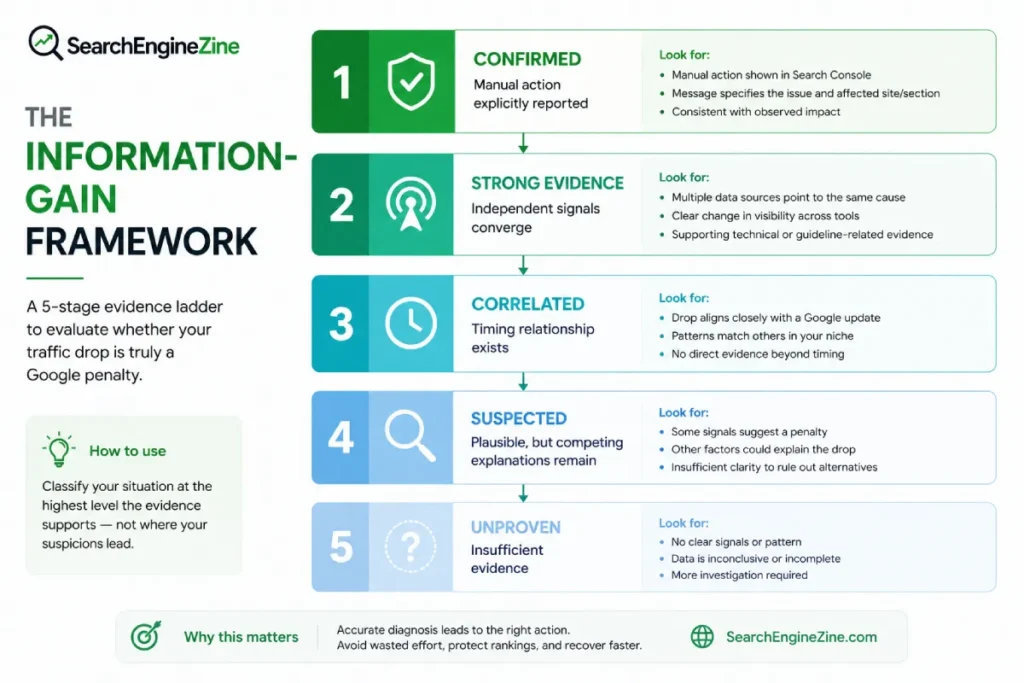
SearchEngineZine’s Penalty Evidence Ladder is a practical editorial framework for separating what is known from what is merely suspected:
| Evidence level | Interpretation |
|---|---|
| Confirmed | A manual action is explicitly reported in Search Console |
| Strong evidence | Multiple independent signals point toward the same explanation |
| Correlated | The decline coincides with an update or another event |
| Suspected | Plausible signals exist, but competing explanations remain |
| Unproven | A decline exists, but there is insufficient evidence to attribute its cause |
This is a SearchEngineZine analytical framework, not a Google scoring system.
That distinction matters.
For example, suppose organic traffic falls sharply during a Google core update. The timing makes the update a reasonable hypothesis. It does not establish that Google manually penalized the site.
A stronger diagnosis considers:
timing + affected queries + affected pages + technical state + SERP changes + search demand + competing explanations.
The objective is to increase confidence in the diagnosis before changing the site.
What to Do After You Identify the Cause
The next action should depend on what the evidence actually shows.
| Diagnosis | Appropriate next action |
|---|---|
| Confirmed manual action | Fix the documented violation and submit a review request |
| Technical/indexing problem | Correct the implementation and verify the affected URLs |
| Possible ranking-system impact | Analyze affected pages, queries, competitors, and relevant Google documentation |
| Search-demand decline | Validate demand and seasonality before making major site changes |
| Competitive displacement | Analyze the SERPs and competing pages |
| Insufficient evidence | Continue investigating rather than making a premature diagnosis |
For a manual action, Google instructs site owners to fix the issue on all affected pages and then request review through the Manual Actions report.
The principle is simple:
Do not choose a recovery tactic before you have a reasonable diagnosis.
When a “Google Penalty” Probably Isn’t a Penalty
Several situations can produce a substantial traffic decline without establishing that Google issued a manual action.
Seasonal or demand change: Search interest can change over time, so compare your Search Console data with broader search trends.
Site migration: URL or site changes can affect Search performance while Google processes the changes.
Technical failure: Crawling, indexing, server, robots.txt, or noindex problems can reduce Search traffic.
Competitive change: Other pages may gain visibility for the same queries, changing your position without a manual action against your site.
Ranking system changes: Google continually updates its ranking systems, and these changes can affect how pages perform. Google also notes that pages moving down after a core update are not necessarily “bad”; other pages may simply become more relevant or useful for the query.
So instead of concluding:
“My traffic dropped, so Google penalized me.”
use the more defensible question:
“My visibility changed. What evidence explains the change?”
That is the difference between a penalty assumption and an SEO diagnosis.
Check Manual Actions → check system/data issues → investigate the decline → test competing explanations → assess the evidence → then act.