

A contextual link is a hyperlink embedded naturally within the body text of a webpage, pointing users and search engines to another relevant resource.
Unlike boilerplate navigation, sidebar, or footer links, contextual links carry immense weight in modern search engine algorithms.
Search engines evaluate the surrounding semantic co-occurrence, paragraph context, and anchor text to assess topical authority and pass targeted link equity.
Because they sit within editorial prose, they signal genuine user utility and deep thematic relevance, making them among the most powerful ranking signals in competitive search landscapes.
What Makes a Link Contextual? (And Why Search Engines Prioritize Them)
The core differentiator of a contextual link is its environment. When a link is hardcoded into global site templates (such as footer credits or sidebar widgets), search engine crawlers discount its thematic significance due to low variance and repetitive placement patterns.
Conversely, a contextual link is dynamically surrounded by sentences, entities, and concepts that reinforce its destination’s core subject matter.
Modern retrieval systems utilize transformer-based models and vector embeddings to parse page content. When a crawler evaluates a contextual link, it analyzes:
- Proximity Vector: The semantic distance between the hyperlink and related topical entities in the same paragraph or sentence.
- Anchor Text Naturalness: The linguistic fit of the clickable anchor within the sentence’s natural reading flow.
- Editorial Intent: Whether the link serves as a reference, citation, data source, or further reading recommendation for human users.
The Semantic Mechanics of Contextual Linking (Anchor Text & Co-Occurrence)
Maximizing the impact of contextual links requires moving beyond rigid, exact-match anchor text strategies that historically triggered spam filters. In contemporary search optimization, anchor text functions as a semantic modifier rather than a blunt keyword instrument.
1. Anchor Text Diversification Matrices
Effective contextual link profiles blend multiple anchor text types to maintain algorithmic safety while signaling clear intent:
- Exact Match: Using the exact primary keyword (use sparingly to avoid over-optimization penalties).
- Partial Match / Modified: Incorporating modifiers or secondary keywords (e.g., “advanced contextual link strategies”).
- Branded / Entity Match: Using brand names or publication titles (e.g., “according to Link building research“).
- Natural / Conversational: Using descriptive phraseology (e.g., “learn how to optimize anchor text effectively”).
2. Co-Citation and Term Frequency-Inverse Document Frequency (TF-IDF)
Search engines analyze the words immediately preceding and following a hyperlink. If you link to a page about “technical SEO audits” using the anchor “site performance review,” the surrounding terms (such as crawl budget, response codes, and server latency) must establish a cohesive semantic bridge. This co-occurrence ensures the link passes contextual relevance without relying solely on the anchor text string.
Contextual Links Acquisition Framework for SEO Professionals
Building and earning high-value contextual links requires a systematic approach that bridges content engineering, digital PR, and technical architecture.
| Strategy Tier | Execution Method | Expected Impact | Risk Level |
| Internal Silo Engineering | Restructuring internal linking architectures using topic clusters and contextual inline links. | High topical authority reinforcement | Low (Fully controllable) |
| Data-Driven Digital PR | Publishing proprietary industry research, benchmarks, or calculators that naturally attract editorial citations. | High authoritative backlink acquisition | Medium (Requires outreach) |
| Broken Link Reclamation | Identifying dead contextual links on high-authority industry resources and proposing your asset as a replacement. | Medium-high link equity transfer | Low-Medium |
| Guest Contribution Architecture | Writing deep, high-density technical articles for industry publications with contextual reference links. | High relevance and referral traffic | Medium (Varies by publisher quality) |
Internal vs. External Contextual Links Architecture
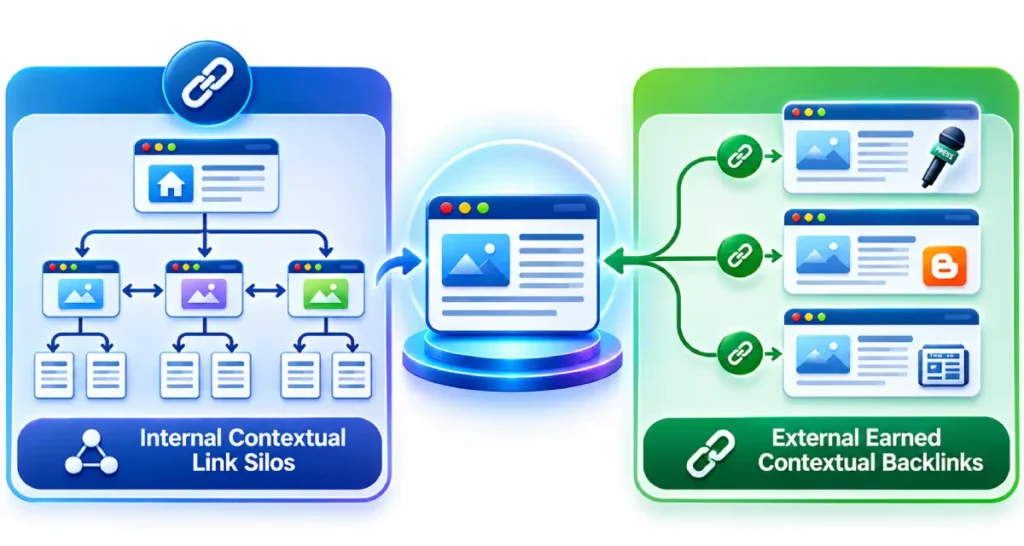
A robust SEO strategy balances both internal contextual links (connecting pages within your own domain) and external contextual links (earned from third-party sites).
Internal Contextual Link Optimization
Internal contextual links dictate how PageRank flows across your site and help search engines discover, crawl, and index deep content. As highlighted in our guide on internal linking best practices, placing contextual links within the first 30% of an article maximizes crawler discovery and reduces bounce rates by guiding engaged readers to logical next steps.
External Contextual Link Acquisition
External contextual links act as votes of confidence from independent domains. When securing these links, prioritize:
- Topical Relevancy: A contextual link from a site in the same vertical carries exponentially more weight than a link from an unrelated directory or low-quality blog network.
- Traffic-Driven Placement: Links positioned on pages that receive active human traffic pass not only link equity but also valuable referral conversions.
Common Pitfalls and Algorithmic Risks
Improper implementation of contextual links can degrade user experience and trigger algorithmic filters. Avoid these common mistakes:
- Forced and Unnatural Placements: Inserting links into random sentences where they add no value to the reader. Modern algorithms detect abrupt topic shifts and discount or penalize unnatural injections.
- Over-Optimization of Anchors: Using identical exact-match anchor texts across dozens of backlinks in a short timeframe, which often triggers manual or algorithmic reviews under Google’s official spam policies for manipulative link building schemes.
- Ignoring Link Velocity: Acquiring hundreds of contextual links overnight without a corresponding growth in organic traffic or brand search volume. Link acquisition must mirror natural content promotion curves.
Conclusion
Contextual links are the bedrock of semantic search optimization. By anchoring hyperlinks directly within rich, authoritative editorial content—both internally across your site architecture and externally through earned digital PR—you provide clear signals to search engines regarding topical depth, relevance, and authority. Prioritize user utility, semantic co-occurrence, and natural anchor text diversity to build a resilient, future-proof link profile.