
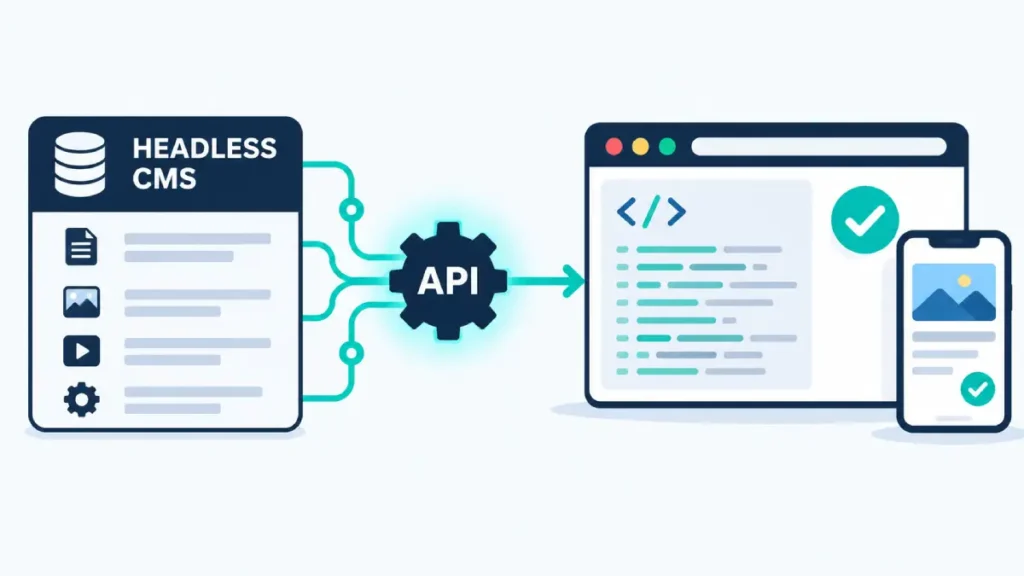
Headless CMS architecture decouples the backend content repository from the frontend presentation layer, delivering structured content via APIs (typically REST or GraphQL) rather than rendering HTML directly from a monolithic template engine.
For SEO professionals, this shift removes out-of-the-box page-level features—such as automatic XML sitemaps, canonical tag generation, and native redirect managers—and transfers full responsibility for crawlability, rendering performance, and metadata injection to the frontend engineering stack.
While a decoupled setup gives engineering teams freedom to build fast, omnichannel digital experiences using frameworks like Next.js, Nuxt, or Astro, it introduces distinct technical SEO risks.
Without deliberate architectural governance, headless migrations frequently result in client-side rendering traps, missing structured data, broken internal link graphs, and stalled content velocity when editors lose visual preview workflows.
Monolithic vs. Headless CMS Architecture: What Changes for SEO
In a traditional (monolithic) CMS such as WordPress or Drupal, the database, backend admin interface, and frontend theme layer live within a single coupled application.
When a search engine bot requests a URL, the server queries the database, processes the theme template, and returns a complete HTML document. SEO plugins hook directly into this lifecycle to inject title tags, meta descriptions, robots directives, and JSON-LD schema automatically.
In a headless architecture, the CMS acts strictly as a structured content database and editorial interface. Content is modeled into discrete fields (e.g., headline, body rich text, author reference, SEO metadata object) and exposed through an API endpoint.
A separate frontend application—often deployed on an edge network or serverless infrastructure—fetches that data and builds the final HTML, CSS, and JavaScript delivered to browsers and search crawlers.
| Architectural Dimension | Monolithic CMS (Coupled) | Headless CMS (Decoupled) | SEO Impact & Governance Requirement |
| Content Delivery | Server-side templates output HTML directly | Content delivered via REST or GraphQL APIs | Frontend must explicitly map API fields to semantic HTML tags (<h1>, <title>, <meta>). |
| Rendering Layer | Tightly coupled PHP, Ruby, or .NET themes | Independent frontend (React, Vue, Svelte, etc.) | Requires deliberate selection of SSR, SSG, or ISR to avoid indexing delays. |
| SEO Controls | Managed via plugins (e.g., Yoast, Rank Math) | Custom-built content models and frontend logic | Teams must build custom schema fields for canonicals, noindex, and redirects. |
| Sitemaps & Robots | Auto-generated on content publish/update | Generated at build time or via serverless routes | Must engineer automated cache invalidation and sitemap regeneration webhooks. |
| Omnichannel Output | Primarily web-focused HTML | Web, mobile apps, IoT, and voice interfaces | Requires separating web-specific SEO metadata from channel-agnostic body content. |
Core Rendering Strategies and Crawlability
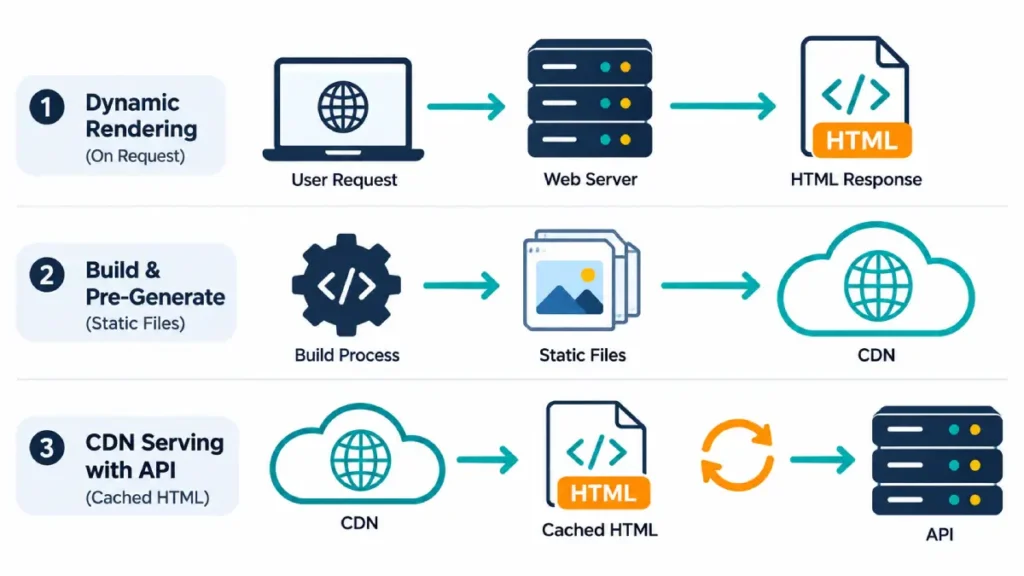
The single most consequential architectural decision in a headless build is how the frontend converts API payloads into indexable HTML.
Googlebot processes JavaScript in a two-wave indexing pipeline—crawling raw HTML first, then queuing pages for rendering when resources permit—as documented in Google Search Central’s JavaScript SEO basics.
Relying on pure Client-Side Rendering (CSR) in a headless stack forces search engines to execute JavaScript before seeing primary content, canonical tags, or internal links.
Server-Side Rendering (SSR)
With SSR, the frontend server fetches content from the headless CMS API on every incoming request, compiles the complete HTML document, and sends it to the client.
- SEO Advantage: Search crawlers receive fully hydrated HTML immediately upon request, ensuring reliable discovery of links, metadata, and structured data.
- Tradeoff: Time to First Byte (TTFB) depends on API response latency and server compute speed. High traffic spikes can strain origin servers or hit CMS API rate limits unless mitigated by aggressive CDN caching (
Cache-Controlheaders).
Static Site Generation (SSG)
With SSG, the frontend queries the headless CMS during the build process and pre-renders every route into static HTML files deployed to a Content Delivery Network (CDN).
- SEO Advantage: Delivers near-instant TTFB and strong Core Web Vitals performance because pre-built HTML is served directly from edge nodes.
- Tradeoff: Build times scale linearly with page count. For enterprise sites with tens of thousands of URLs, full rebuilds on every minor typo fix become operationally unviable.
Incremental Static Regeneration (ISR) and Hybrid Rendering
Modern meta-frameworks support hybrid approaches—such as Incremental Static Regeneration (ISR) or stale-while-revalidate caching patterns—allowing static pages to update in the background after deployment without rebuilding the entire site.
- SEO Advantage: Combines the edge-delivery speed of SSG with the content freshness required for news, e-commerce inventory, and rapidly updated documentation.
- Tradeoff: Requires careful webhook configuration between the CMS and frontend hosting layer so content updates purge stale edge caches predictably.
Designing an SEO-Complete Content Model
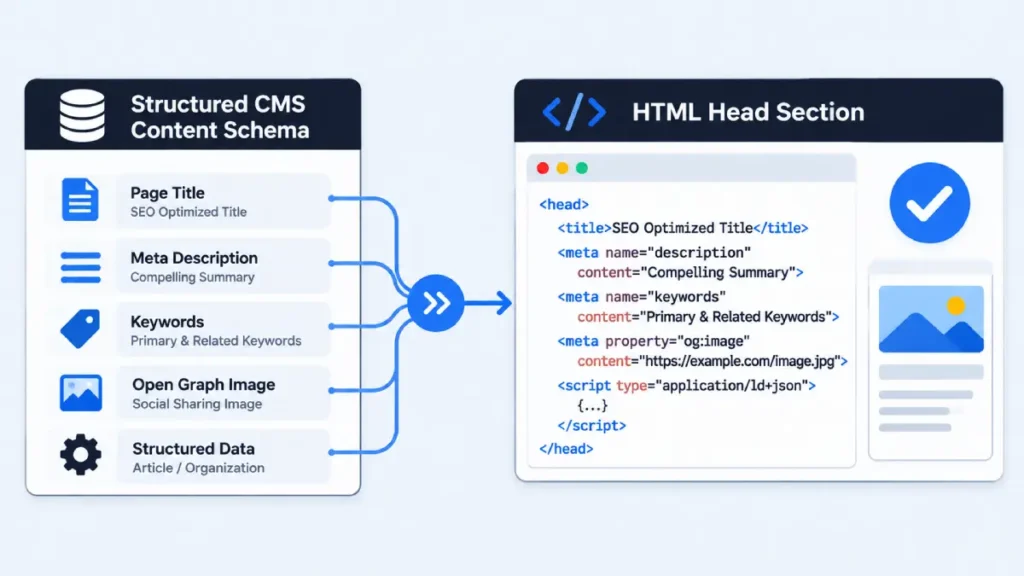
In a headless CMS, if an SEO field is not explicitly defined in the content model, editorial teams cannot control it without developer intervention.
Before writing frontend templates, SEO strategists and solution architects must establish a standardized SEO Metadata Component attached to every indexable page type.
Essential Fields for the Headless SEO Component
- Meta Title (
meta_title): Plain text field with character-count validation guidelines and fallback logic to the primary pageH1if left blank. - Meta Description (
meta_description): Text area field with fallback behavior or deliberate empty-state handling. - URL Slug (
slug): Unique, validated string field enforcing lowercase characters, hyphens, and strict lock-on-publish rules to prevent accidental URL changes. - Canonical URL Override (
canonical_url): Optional URL field allowing SEOs to point duplicate or syndicated pages to an authoritative source. By default, the frontend should self-canonicalize using the clean production URL without tracking parameters. - Robots Directives (
robots_index,robots_follow): Boolean toggles (defaulting totrue) that output<meta name="robots" content="noindex, nofollow">when disabled. - Open Graph & Social Fields (
og_title,og_description,og_image): Structured fields ensuring social shares render accurately when links are distributed outside organic search. - Structured Data Overrides (
custom_json_ld): A validated JSON field enabling SEO teams to deploy bespoke Schema.org markup (such asFAQPage,HowTo, or custom entity graphs) on specific URLs without waiting for a sprint release.
Preventing Rich-Text Semantic Drift
Headless editors often use block-based rich-text editors (such as Portable Text or structured JSON blocks) rather than raw HTML. Ensure the frontend serializer maps heading blocks strictly to <h2> through <h6>, reserving <h1> exclusively for the page’s primary title field.
Additionally, enforce mandatory alt text fields on image asset models at the CMS schema level so editors cannot publish media assets without descriptive attributes.
Critical Technical SEO Infrastructure to Engineer Explicitly
Because headless platforms separate content storage from routing and delivery, several baseline SEO mechanisms must be engineered intentionally into the frontend application or edge layer.
Dynamic XML Sitemaps
A headless frontend must generate XML sitemaps dynamically via a server route (e.g., /sitemap.xml) or regenerate them automatically via webhooks whenever content is published, updated, or unpublished in the CMS.
- Exclude any entry where
robots_indexis set tofalseor wherecanonical_urlpoints to an external or alternate URL. - Update
<lastmod>timestamps strictly when substantive content changes occur, avoiding automated timestamp updates during routine code deployments. - Segment sitemaps into a sitemap index file once URL counts approach the 50,000-URL or 50MB uncompressed limit specified by sitemaps.org.
Edge-Level Redirect Management
Without a traditional .htaccess file or CMS redirect plugin, 301 and 302 redirects in a headless stack must live at the CDN/edge middleware layer (e.g., Cloudflare Workers, Vercel Edge Middleware, or AWS CloudFront Functions) or pull from a dedicated Redirect content type in the CMS.
- Store redirects in a fast key-value store at the edge so redirect lookups execute in single-digit milliseconds before hitting the origin server.
- Build automated redirect triggers into the CMS webhook pipeline: if an editor modifies an existing published
slug, the system should automatically create a301redirect from the legacy path to the new path and flag any redirect chains.
Internal Linking and Pagination Architecture
Single-Page Application (SPA) navigation frameworks often rely on JavaScript onClick handlers or <button> elements to transition between views. For search crawlers to discover deep pages and distribute internal link equity:
- Render all navigation, breadcrumbs, and pagination links using standard HTML
<a href="/target-path">tags. - Avoid infinite-scroll implementations that hide subsequent items behind scroll events; pair any dynamic loading UI with crawlable paginated URLs (
/blog?page=2or/blog/page/2) using self-referencing canonical tags.
Internationalization (hreflang) Routing
For multi-regional headless builds, locale variants are typically managed at the field level or document level inside the CMS.
The frontend routing layer must query all published locale versions of a given entry ID to dynamically inject reciprocal <link rel="alternate" hreflang="..."> tags and x-default annotations in the document <head>.
Evaluating Headless vs. Hybrid Architectures for SEO Teams
Moving to a pure headless architecture is not universally advantageous for content-led websites. Marketing and SEO teams frequently underestimate the operational friction created when visual page building and live preview capabilities disappear.
| Evaluation Factor | Pure Headless Architecture | Hybrid / Composable Architecture | Traditional Monolithic CMS |
| Editorial Autonomy | Low; editors rely on rigid fields and developer-built components. | Moderate to High; combines API delivery with visual layout builders. | High; full visual theme and plugin control. |
| Frontend Performance | High potential (edge-cached SSG/ISR), dependent on JS bundle discipline. | High potential when frontend hydration is controlled. | Moderate; requires caching layers and plugin optimization. |
| SEO Feature Velocity | Slow initially; requires engineering tickets for new schema or meta rules. | Moderate; core SEO controls built-in, custom logic via API. | Fast; immediate access to mature SEO plugins. |
| Best-Fit Use Case | Multi-platform apps, complex web applications, high-security enterprise portals. | Content-heavy brands scaling across web and mobile with visual editing needs. | Content-driven publishers, blogs, and SMBs prioritizing rapid editorial execution. |
Decision Rule: If your digital presence is primarily a single website where editorial velocity, frequent landing page experimentation, and rapid SEO testing drive growth, a monolithic or hybrid CMS typically yields higher ROI.
Adopt a pure headless architecture when you must syndicate structured content across multiple frontends (web, native iOS/Android, in-store displays) or when your frontend engineering stack requires decoupled microservices.
Pre-Launch SEO Governance Checklist for Headless Builds
Before cutting DNS over to a new headless frontend, SEO and engineering leads should validate the following controls in a staging environment protected behind HTTP authentication:
- Raw HTML Source Inspection: Disable JavaScript in the browser or inspect the raw HTTP response (
curl -s <URL>) to confirm that the<title>, meta description, canonical tag,<h1>, primary body copy, internal<a href>links, and JSON-LD structured data appear in the initial server response. - Status Code Verification: Confirm non-existent routes return a true HTTP
404status code rather than rendering a “Not Found” UI template on top of an HTTP200response (soft 404). - Parameter and Trailing Slash Normalization: Enforce consistent trailing slash rules (either always present or always absent) via
301redirects and strip non-essential tracking parameters from self-referencing canonical URLs. - JavaScript Bundle and Core Web Vitals Audit: Verify that heavy client-side hydration does not degrade Interaction to Next Paint (INP) or Largest Contentful Paint (LCP), referencing Google Search Central’s Core Web Vitals documentation.
- Webhook and Cache Invalidation Test: Publish a test update in the CMS, measure the exact propagation delay until the live edge-cached HTML reflects the change, and confirm the XML sitemap updates simultaneously.