

LLM review synthesis is the structured process of using large language models to extract recurring themes, product attributes, sentiment patterns, and real-world use cases from large collections of customer reviews—and turning those findings into accurate, search-useful content, schema-aligned product or entity descriptions, and conversion improvements.
For SEO professionals in the United States, raw review feeds are often too noisy to read manually at scale yet too nuanced to summarize with basic keyword frequency counts alone.
A single five-star review might praise fast shipping while quietly noting an awkward fit, whereas a cluster of three-star reviews often reveals exact buyer objections that searchers type into Google or conversational AI interfaces.
When executed with strict human verification and grounding, review synthesis helps SEO teams align pages with real buyer intent without fabricating claims or drifting into thin, repetitive copy.
Why Review Synthesis Matters for Modern Search and Discovery
Searchers rarely evaluate a product, service, or local business through a single dimension. Someone researching enterprise software, a local service provider, or a consumer tool wants to know where it excels, where it falls short, which user profile benefits most, and how trade-offs play out over time.
Review repositories hold this exact decision context, but unstructured text creates three operational problems for SEO teams:
- Volume vs. signal: Hundreds or thousands of reviews obscure high-frequency patterns behind anecdotal extremes.
- Vocabulary mismatch: Customers describe problems in everyday or domain-specific terms that differ from internal marketing slogans.
- Hallucination risk in automation: Unconstrained LLM summaries can invent features, exaggerate consensus, or blend unrelated feedback into a single claim.
Connecting review insights back to broader site architecture is essential. Understanding how semantic SEO foundations shape topical coverage helps teams treat review themes as structured topical and entity context rather than isolated ad-hoc blurbs.
Similarly, when evaluating how AI systems surface and cite information, teams benefit from grounding their workflows in generative engine optimization principles so synthesized summaries remain clear, attributable, and useful rather than overly promotional.
Core Dimensions to Extract From Customer Reviews
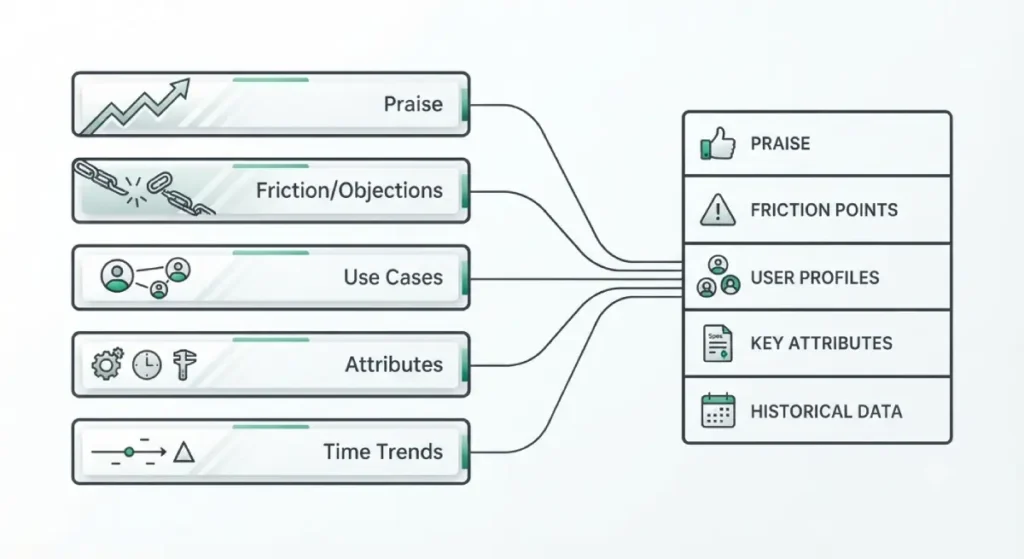
Effective LLM review synthesis starts before you write a prompt. If you ask a model simply to “summarize these reviews,” it usually returns generic praise and complaints that add little value to an SEO or conversion workflow.
Instead, define an extraction schema tailored to the page type and search intent, following structured output and JSON schema guidelines.
| Extraction Dimension | What to Capture From Reviews | Primary SEO & Content Use |
| Recurring Praise Themes | Specific strengths mentioned repeatedly across independent reviews | Validate value propositions and highlight genuine differentiators |
| Friction & Objections | Recurring complaints, setup hurdles, pricing caveats, or limitations | Build transparent pros/cons, FAQs, and expectation-setting copy |
| Use Cases & Personas | Who uses the offer and in what scenarios or workflows | Match long-tail informational and commercial queries to real contexts |
| Attribute & Feature Mentions | Concrete specs, integrations, durability, support speed, or turnaround | Enrich product/service comparisons and structured attributes |
| Sentiment Shifts Over Time | Changes across dates or versions (for example, new UI or policy shifts) | Prevent outdated claims and flag stale landing page sections |
Separating Consensus From Outliers
One of the most common mistakes in AI-assisted analysis is treating a single vivid review as a major trend. A vocal reviewer may have an unusual edge case or misconfigure a tool. Requiring approximate mention counts, representative quotes, and clear boundaries between majority sentiment and minority caveats keeps your editorial output grounded.
A Practical Workflow for SEO Teams
A repeatable pipeline helps prevent prompt drift and ensures every claim traced back to reviews can be audited before publication.
1. Segment and Clean the Input Sample
Group reviews by product, service tier, location, or time window before sending them to the model. Mixing unrelated SKUs or multi-year historical periods into one batch blurs context. Strip duplicate entries, obvious spam, and personally identifiable information where appropriate, and keep metadata such as rating, date, and source intact when available.
2. Run Structured Extraction Rather Than Freeform Summarization
Instruct the model to return structured outputs—such as JSON or a standardized table—containing theme labels, polarity (positive, negative, mixed), frequency indicators, supporting evidence snippets, and unresolved ambiguities.
Asking for verbatim short phrases or exact review identifiers makes human spot-checking significantly faster—a technique aligned with citation-grounded extraction practices.
3. Map Themes to Search Intent and Page Sections
Not every review theme belongs on every URL. High-level overview pages need broad theme synthesis and trade-off framing, whereas comparison or alternative pages benefit from side-by-side strengths and limitations. Aligning findings with keyword intent mapping practices ensures you answer what a searcher actually needs at that stage rather than dumping raw feedback onto a page.
4. Audit Against Source Reviews and Grounded Facts
Before publishing any synthesized takeaway, verify that the claim accurately reflects the underlying reviews and does not contradict official product documentation or current pricing/terms. If a review mentions a feature or limitation that is ambiguous, label it as reported feedback rather than an absolute fact.
Where Review Synthesis Helps—and Where It Hurts SEO
Used carefully, synthesized review insights improve clarity, specificity, and topical completeness. Used carelessly, they can introduce compliance risks, duplicate patterns, or weak E-E-A-T signals.
| Approach | Potential Upside | Key Risk to Watch |
| Synthesized theme tables & trade-off blocks | Helps readers weigh fit, pros, and limitations quickly | Can become repetitive if identical templates are copied across pages |
| FAQ & objection-handling sections | Directly addresses real buyer hesitations and long-tail questions | Risk of inventing answers not supported by source data or docs |
| Entity & attribute enrichment | Surfaces real-world use cases and terminology tied to the subject | Model may conflate similar products or hallucinate specifications |
| Automated mass review rewrites | Saves time on large catalogs or multi-location sets | High risk of subtle hallucinations, stale claims, and generic prose |
For teams working with large datasets or automated pipelines, pairing editorial review with disciplined data governance and auditing practices reduces the chance that unverified model outputs slip into live production pages.
Likewise, when evaluating how review text is parsed and categorized at scale, understanding intent and entity mapping approaches for LLMs
alongside Google’s people-first content guidelines helps keep taxonomy consistent and useful across content hubs.
Guardrails Against Hallucinations and Thin Content
LLMs are fluent predictors, not ground-truth databases. Even when given real reviews, a model may extrapolate beyond what reviewers actually wrote—for instance, inferring that a tool supports an integration merely because one reviewer mentioned exporting data.
Follow these guardrails to protect editorial quality in the US market:
- Require attribution to the review set: Frame insights around what reviewers report (such as “Reviewers frequently highlight…” or “A recurring complaint involves…”) rather than presenting subjective opinions as objective law.
- Keep quotes and claims proportional: Avoid presenting a minor caveat as a universal flaw, and avoid turning lukewarm praise into exaggerated endorsements.
- Watch for cross-page sameness: If you synthesize reviews across multiple categories or locations, vary your framing and focus on distinct differentiators so pages do not read like templated clones.
- Respect platform and policy rules: Never fabricate customer reviews, alter star ratings, or present AI-generated summaries as verified first-party testimonials, in accordance with Google Search review snippet structured data policies and FTC consumer review rules
If you are building structured workflows around review analysis, reviewing broader enterprise AI data auditing methods can also help you establish repeatable spot-check thresholds before content goes live.
Practical Next Steps for Your Content Team
Start small with a single high-priority page or cluster where buyer decision friction is clear. Pull a clean sample of recent reviews, run a structured extraction prompt focused on top praises, top objections, and distinct user scenarios, and manually spot-check a sample of source reviews against the output. Once the extraction format proves reliable and accurate, integrate those verified insights into your content briefs, comparison sections, and refresh cycles.